






PV Announces Release of New Pelli-Robson Contrast Sensitivity Tests
New Pelli-Robson Contrast Sensitivity Tests Available for Immediate Delivery
Advancing Clinical Precision with Original Gold Standard Trans-Illuminated Charts
Precision Vision announced today that it has added to its line of Contrast Sensitivity tests through the addition of the Pelli-Robson Near Vision Contrast Sensitivity Chart (Cat. No. 5013) Set, the trans-illuminated Contrast Sensitivity Chart for Low Vision (Cat. No. 5016), and Peak Contrast Sensitivity (Cat. No. 5017).
Designed by DG Pelli, JB Robson and AJ Wilkins, these tests provide a realistic assessment of how well a patient sees large, faint objects. Testing contrast sensitivity on a regular basis is key to detecting early signs of diseases such as Parkinson's, Glaucoma, and Cataracts. By testing with several different contrast levels configured together, the patient's sensitivity level is better assessed and records will be more precise.
The chart organizes letter sequences into groups of three (triplets) with two triplets per line. Within each triplet, all letters have the same contrast. The contrast decreases from one triplet to the next, even within a single line. Additionally, this chart follows the luminance, font, and letter spacing recommendations of the Committee on Vision of the National Academy of Sciences and National Research Council.
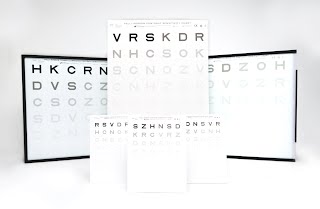
Pelli-Robson Triplet Contrast Sensitivity Configuration
The Trans-Illumination Advantage
The trans-illuminated versions are identical to the original "Gold Standard" Pelli-Robson Contrast Sensitivity Charts. These charts cover 3/4 of the original range, are manufactured to the same true log steps, and use the same letters and letter sizes as the originals.
Trans-illumination has the advantage of uniform fixed illumination, completely eliminating the need for staging the room and verifying chart luminance with room lighting.
Upgrade Your Contrast Sensitivity Diagnostics
These advanced charts require using our ETDRS Illuminator Cabinet™, Cat. No. 2425. Get complete details and expand your clinical testing protocols today.