





What is Stereo Vision Screening and What Are the Different Types of Stereo Vision Tests?
Stereo Depth Perception Testing
An Effective, Easy-to-Use Method for Screening Stereoscopic Vision Defects Across All Ages
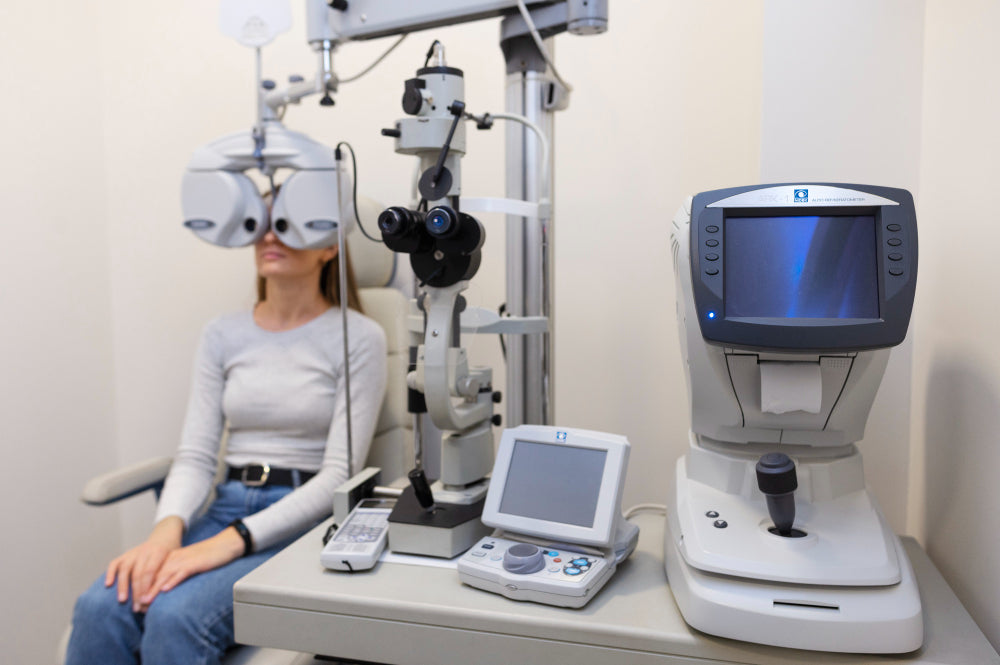
Stereo depth perception tests are an exceptionally efficient method of evaluating binocular vision health. By identifying subtle discrepancies in how an individual's eyes track together, these screeners help clinicians quickly detect underlying visual problems such as diminished stereopsis, amblyopia, suppression, and strabismus before they impede long-term development.
Understanding Stereoscopic Vision & Stereo Vision Tests
Commonly referred to as stereopsis, stereo vision, depth perception testing, or stereoscopic vision, this critical visual process relies upon high-quality retinal images from both eyes being precisely matched in the brain to obtain high-fidelity estimates of binocular disparity. Stereoscopic depth perception is one of the primary evolutionary advantages of binocular vision, achieved by calculating horizontal binocular retinal disparity alongside estimates of optical arc and distance. Consequently, an individual's stereoacuity is intimately linked to their baseline optical quality, as determined by the specific optical wavefront aberrations of both eyes. Looking at it from a public health perspective, a loss of accurate depth perception is associated with distinct deficits in motor skill execution, leading to notable self-reported challenges that significantly lower vision-related quality of life.1, 2
Why Screen for Stereo Vision?
True stereopsis is determined by both of a patient’s eyes working in unison to synthesize a cohesive three-dimensional mental image. While depth perception is heavily dictated by the degree of biological stereopsis, the human visual system also relies on alternative monocular cues to process space.
In an extreme clinical example where a patient has only one properly functioning eye, that individual will exhibit zero stereopsis. However, they will retain basic depth perception through alternative monocular observations. Well-developed stereo vision assists immensely in everyday functional tasks, like safely crossing a busy street or walking down a flight of stairs without the risks of distance misjudgment.3
Key Examples of Monocular Cues:
- Image Size Disparity: Objects positioned further away naturally appear smaller to the retina.
- Motion Parallax: Elements located deep in the background appear to translate across the visual field much slower than closer objects.
- Interposition / Blocking: If an object partially obscures the sightline of another, the mind automatically determines that the blocking element is in front.
Simple daily interactions involving learning environments, standard driving navigation, functional mobility, and competitive sports are easily compromised by poor stereopsis. For young students, undiagnosed stereoscopic anomalies can quickly cause systemic learning difficulties. A child struggling with hidden Amblyopia (Lazy Eye), Diplopia (Double Vision), or Strabismus (Crossed-Eyes/Eye Turns) will experience significant strain attempting to resolve chalkboards, text books, or digital instructional materials.
Outside the classroom, basic home tasks as routine as pouring a warm beverage, stepping down stairs, or operating a motor vehicle safely can become challenging. Furthermore, depth perception helps athletes calculate moving distances between themselves and a ball, player, or goalpost, making fine stereopsis crucial for judging the real-time flight vectors of objects in motion around them.
Types of Stereo Vision Tests & How They Differ
Most baseline ophthalmic stereo tests are designed to rapidly isolate and evaluate both gross stereopsis levels and fine depth perception thresholds. The following matrix offers a professional comparative overview of the industry-standard screening modalities available today:
| Test Modality | Adult | Pediatric | Gross Stereopsis | Depth Perception | Near | Distance | Glasses Required |
|---|---|---|---|---|---|---|---|
| Stereo Fly | ✓ | ✓ | ✓ | ✓ | ✓ | — | ✓ |
| Randot® Stereotest | ✓ | ✓ | ✓ | ✓ | ✓ | — | ✓ |
| Stereo Butterfly | ✓ | ✓ | ✓ | ✓ | ✓ | — | ✓ |
| FBAT™ Booklet | — | ✓ | ✓ | ✓ | ✓ | — | ✓ |
| Bernell Stereo Book | ✓ | ✓ | ✓ | ✓ | ✓ | ✓ | ✓ |
| Random Dot "E" | — | ✓ | ✓ | — | ✓ | — | ✓ |
| BEST Dinosaur | — | ✓ | ✓ | ✓ | ✓ | — | ❌ No |
| Lang-Stereotest® I-R | ✓ | ✓ | ✓ | — | ✓ | — | ❌ No |
The Original Stereo Fly Test
The Stereo Fly Test has established itself globally as an exceptionally reliable and straightforward standard for assessing stereoscopic vision across all patient demographics. By introducing structured spatial challenges, it empowers practitioners to rapidly diagnose developmental defects including amblyopia, spatial suppression, and strabismus.
- Gross Stereopsis Isolation: Accurately measures levels spanning from 355 down to 700 seconds of arc.
- Graded Circle Sequence: Refines assessment down to ultra-precise margins ranging from 800 to 40 seconds of arc.
- Integrated Children's Section: Features stylized animal indicators graded from 400 down to 100 seconds of arc to maintain pediatric engagement.
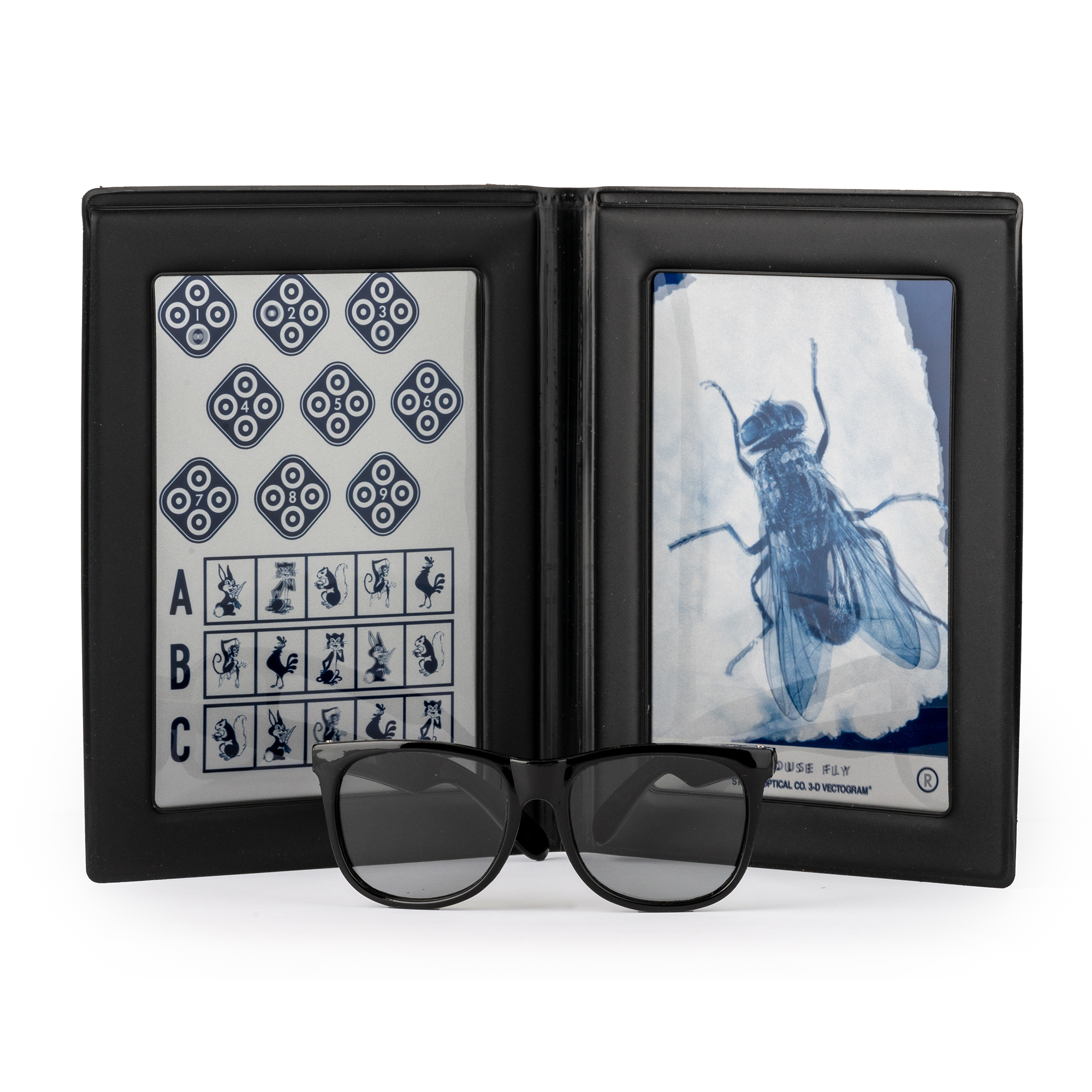
Standard polarized Stereo Fly screening setup.
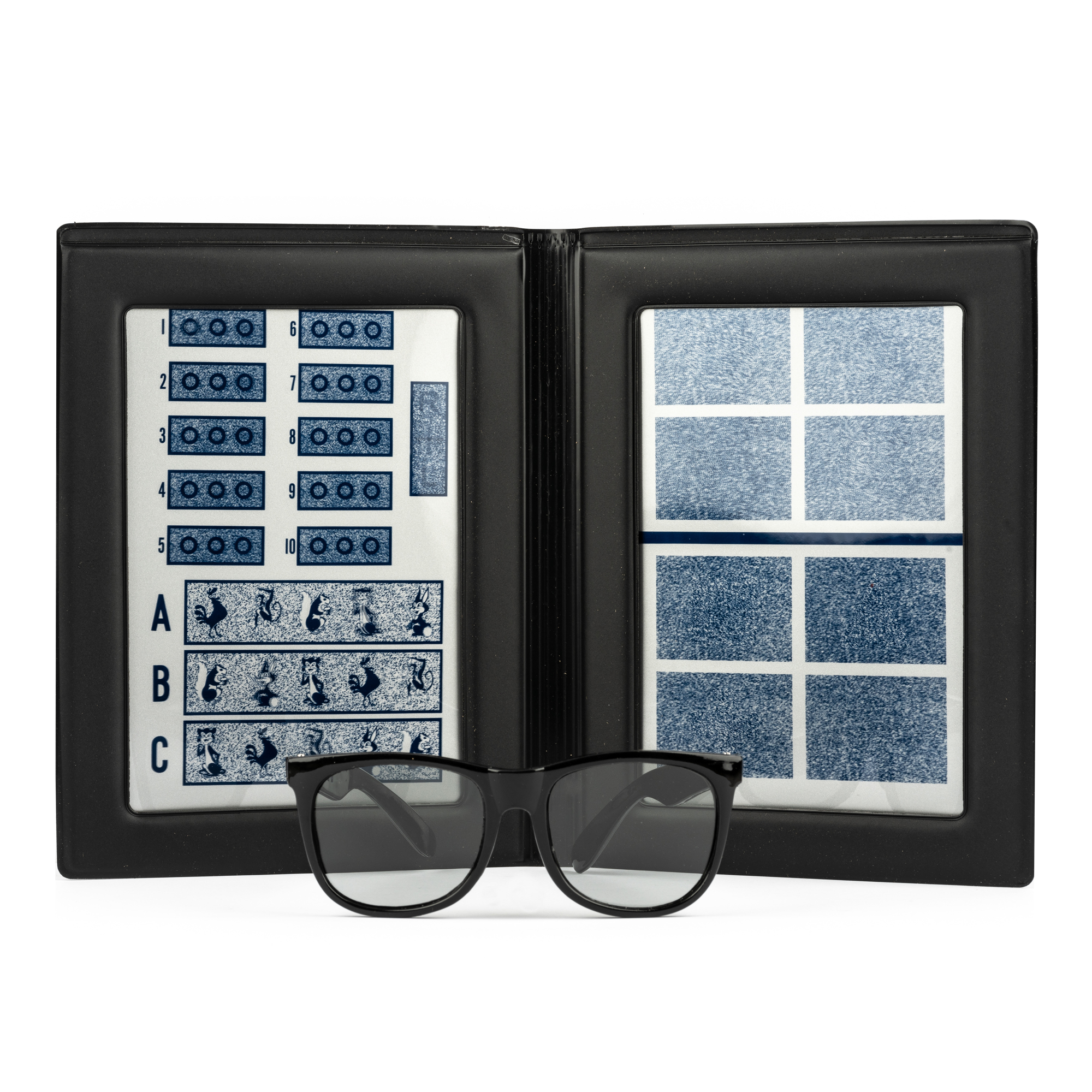
Randot® geometric shape assessment matrix.
Randot® Stereotest
Engineered principally for advanced adult diagnostics while integrating pediatric modules, the Randot® Stereotest asks mature patients to discern six distinct geometric forms embedded in complex random-dot backgrounds. This protocol rigorously assesses deep-field perception alongside normal operational stereo vision.
- Random Dot Background Evaluation: Evaluates gross stereopsis metrics at specific 500 and 250 seconds of arc milestones using geometric matrices.
- Graded Circle Tests: Maps a detailed performance curve from 400 down to 20 seconds of arc.
- Pediatric Target Ranges: Measures child responses reliably between 400 and 100 seconds of arc.
Butterfly Stereotest
The Stereo Butterfly provides highly accurate, randomized assessments targeting gross stereopsis (2500 to 1200 seconds of arc) alongside fine depth acuity. A key security feature distinguishing the Butterfly test from legacy formats is that its diagnostic figures remain completely invisible unless viewed through polarized glasses, effectively eliminating patient guesswork.
- Graded Circle Sequencing: Ranges seamlessly from 800 down to 40 seconds of arc.
- Pediatric Optimization: Standardized animal symbols map vision acuity from 400 to 100 seconds of arc.
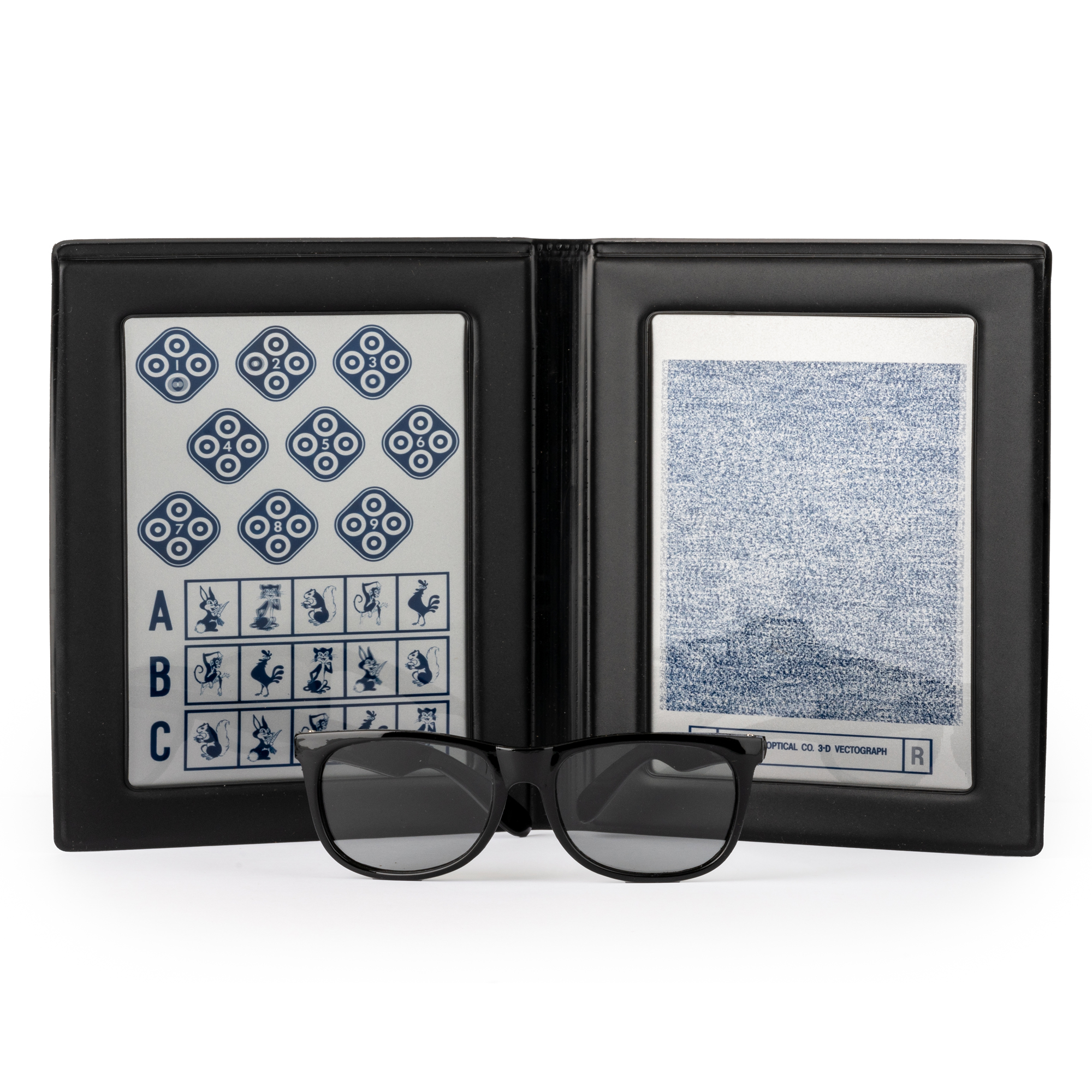
Stereo Butterfly random dot stereopsis booklet.
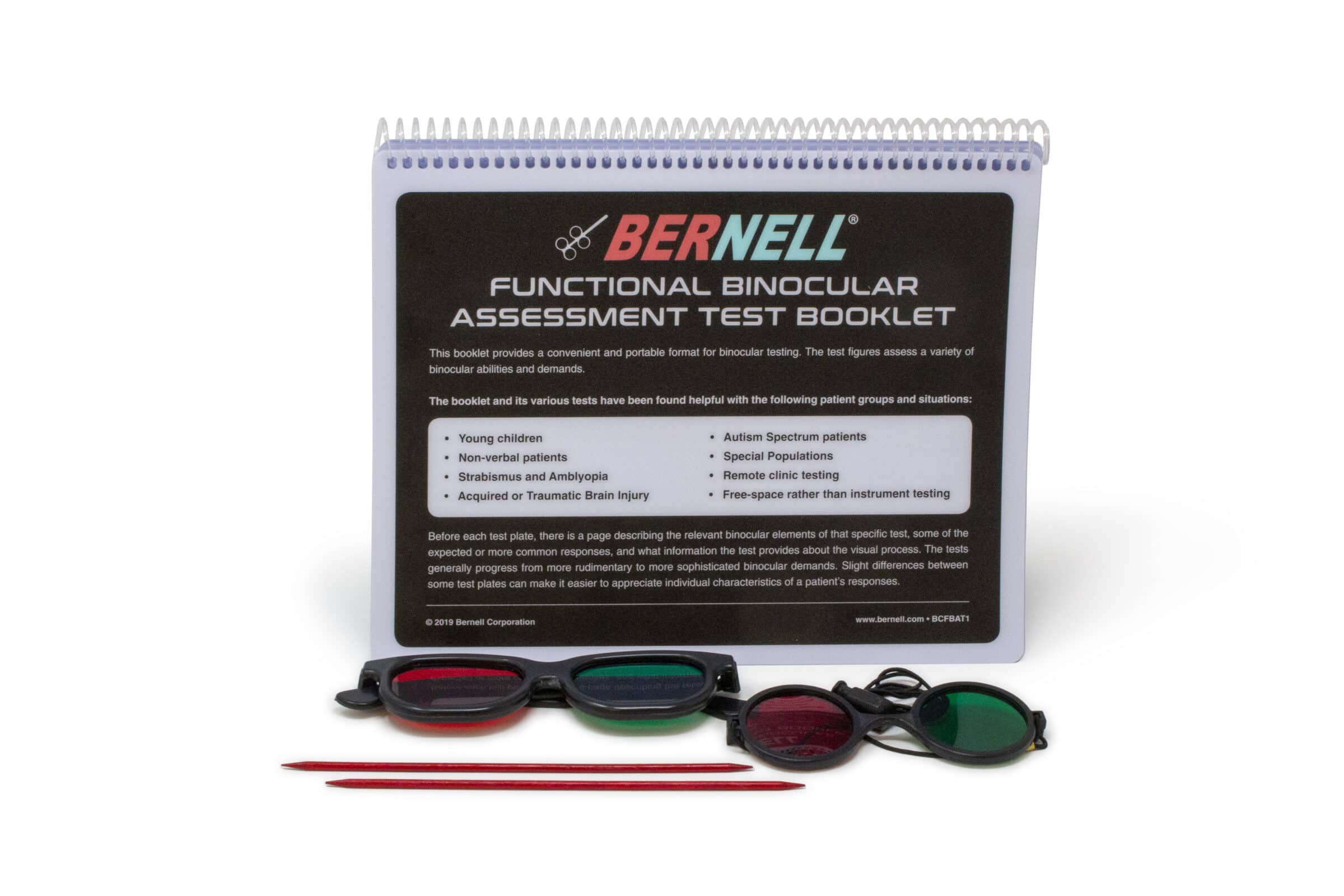
Bernell FBAT™ non-verbal evaluation format.
Bernell Functional Binocular Assessment Test Booklet (FBAT™)
Co-developed in direct partnership with leading clinical specialists Dr. Gregory Kitchener and Dr. Paul Harris, the portable Bernell FBAT™ uses precise anaglyph target filters to examine binocular mechanics across varied populations. It is an exceptional diagnostic choice for testing older infants, toddlers, and non-verbal patients.
Because these cohorts will reflexively reach into the air to grasp the highly isolated 3D figures emerging from the page planes, examiners can confirm both functional stereopsis and localization simultaneously. Built-in variation of peripheral fusion locks and central references helps clinicians accurately categorize strabismic performance.
Bernell Stereo Test Book: Near & Far Custom Booklet
This cost-effective, combined screening solution blends three standard variations of stereoscopic evaluation testing into a single, highly durable multi-page booklet package.
Comprehensive Targets Included:
-
Near Stereo Acuity Mapping: Assesses gross and fine perception thresholds.
- Phase 1 (Large Sports Figures): Fixed intervals at 1500", 1250", and 900" of arc.
- Phase 2 (Small Sports Figures): Mid-tier screening at 400", 200", and 100" of arc.
- Phase 3 (Octagon Matrix): Advanced fine tuning scaling from 800" down to 40" of arc.
-
Distance Stereo Acuity Protocols: Measures gross stereopsis at standard far testing ranges.
- Tracks response values across primary vectors at 180" (Top Line), 120" (Middle Line), and 60" (Bottom Line) of arc.
-
Random Dot Target Arrays: Custom shape blocks that completely suppress monocular tracking hints.
- Graduated test fields mapping circles and shapes down to a demanding 25 seconds of arc.
Multi-page Red/Green Tranaglyph™ booklet structure.
Random Dot “E” Stereotest
Formally recommended by both the American Academy of Ophthalmology (AAO) and the American Academy of Pediatrics (AAP), this test is engineered specifically to screen toddlers and children from age three upward.
The pediatric patient is asked to successfully differentiate between a clear stereoscopic "raised E" target and a non-stereo card blank. Because the letter forms are entirely indistinguishable to the naked eye without specialized polarization viewing glasses, guessing artifacts are completely removed from the screening documentation.
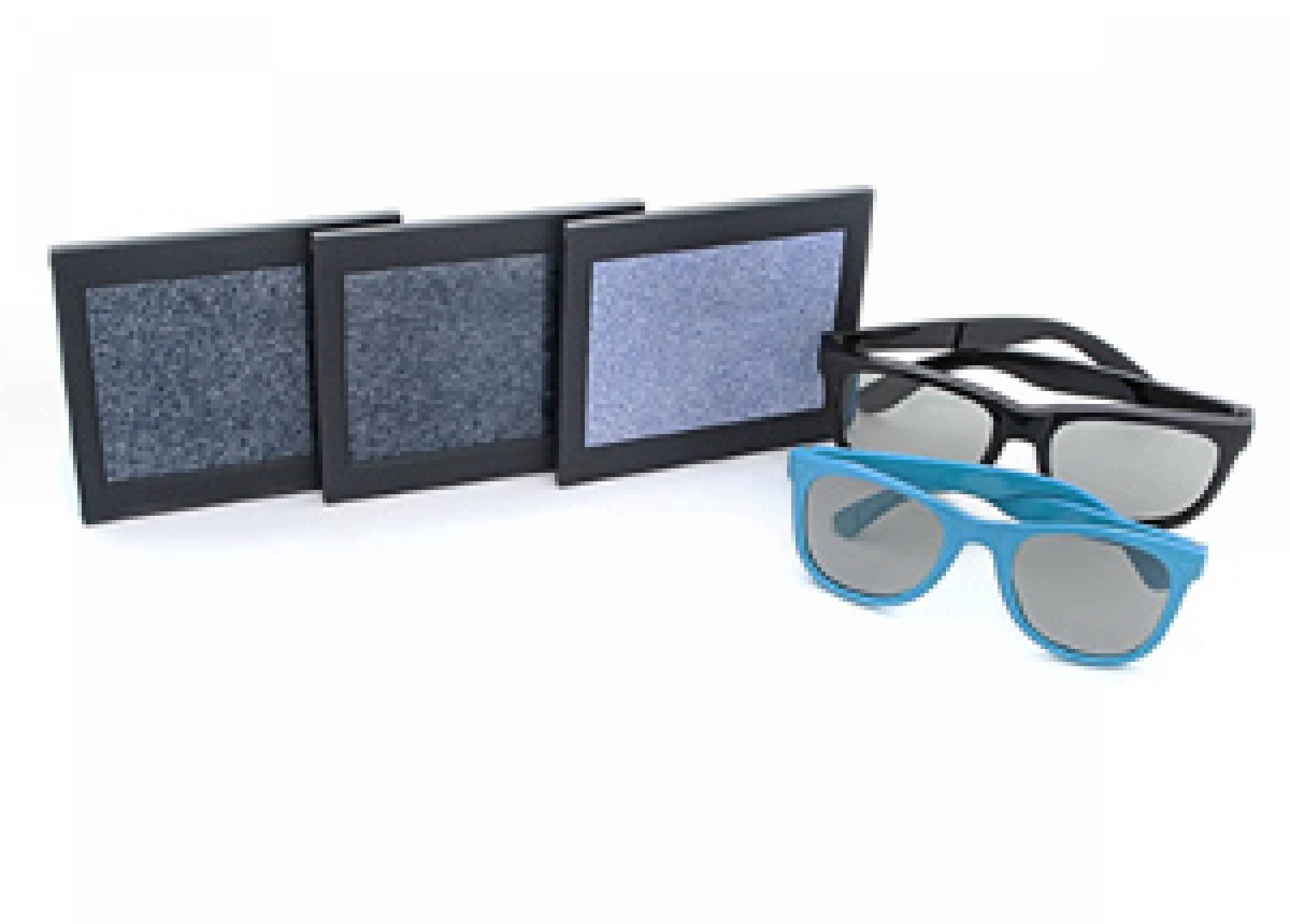
Random Dot "E" card testing set with polarized glasses.
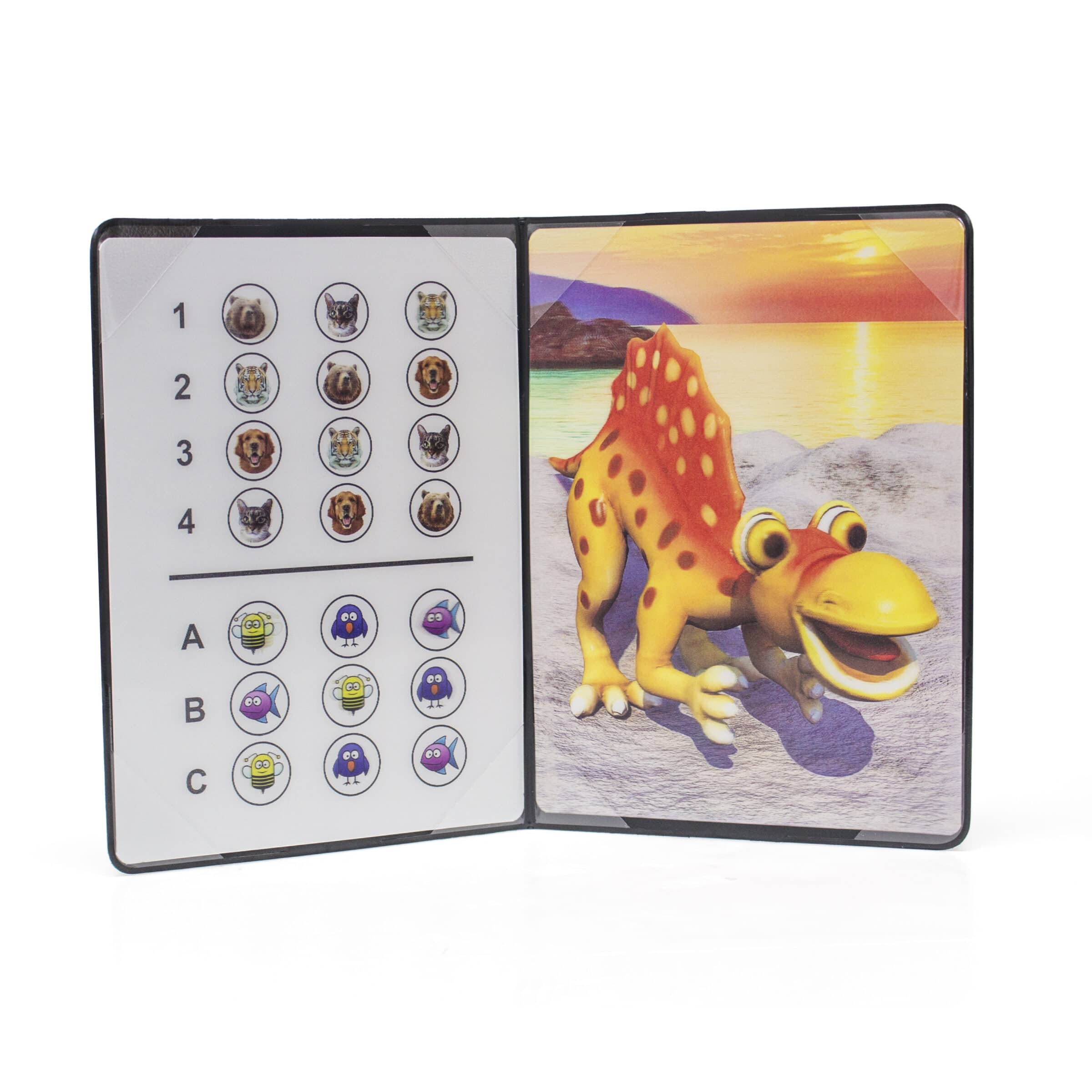
Lenticular glasses-free dinosaur screening card.
Bernell Evaluation of Stereopsis Test (BEST) - Dinosaur Version
This highly popular, glasses-free depth perception tool leverages high-grade lenticular printing technology to produce deep, brilliant 3D target visuals without demanding the use of cumbersome polarized or red/green glasses. This makes it an ideal screening option for highly sensitive pediatric patient groups.
- Plate 1 (Gross Stereopsis): Features a central, high-contrast Dinosaur figure optimized for immediate macro depth verification.
- Plate 2 (Fine Depth Perception Matrix): Split into two distinct diagnostic sub-tests containing rows of graded shapes progressing from 400" down to a highly fine 40" of arc.
Lang-Stereotest® I-R
The Lang-Stereotest® I-R stands as a premier, highly sensitive orthoptic instrument for the professional screening of complex binocular vision disorders in both adult and young pediatric cohorts. By combining a precise random-dot matrix layer natively over fine lenticular lenses, no specialized screening glasses are required during examination.
This glasses-free configuration provides a tremendous clinical advantage, allowing the attending specialist to monitor and evaluate a patient's natural compensatory eye movements directly during testing.
Standardized 3D Targets & Disparities:
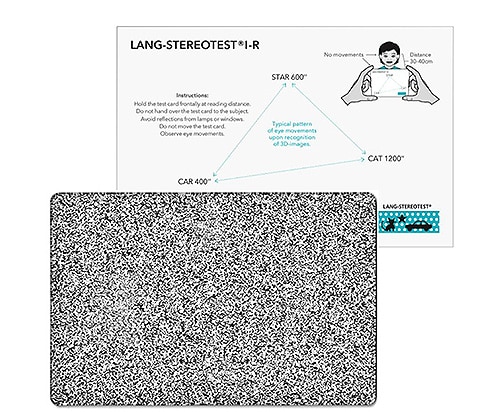
Lang-Stereotest® I-R magnetic diagnostic panel.
Clinical Considerations & Diagnostic Compliance
In summary, while the utility of stereoscopic vision tracking within daily human life is indisputable, accurate diagnostic evaluation is consistently influenced by external co-morbidities. Variables such as uncorrected refractive errors, reduced contrast sensitivity, aniseikonia, amblyopia, and manifest strabismus can alter performance markers.
To date, no single testing strategy completely bypasses all of these overlapping optical variables.6-10 Because every stereo screener has distinct structural advantages and mechanical boundaries, clinical practices are highly encouraged to implement a diversified battery of testing tools. Deploying varied technological strategies guarantees a multi-dimensional, accurate, and completely reliable assessment of stereoscopic health.11
Ensure Your Diagnostic Tools Are Accurate
Protect the validity of your optical research data and patient diagnostic charts. Contact Precision Vision today to talk with a screening specialist or order authorized testing inventories.
Scientific Citations & Clinical Sources:
- Metlapally S, Bharadwaj SR, Roorda A, Nilagiri VK, Yu TT, Schor CM. Binocular cross-correlation analyses of the effects of high-order aberrations on the stereoacuity of eyes with keratoconus. Journal of Vision. 2019;19(6):12. https://doi.org/10.1167/19.6.12
- Gillam B, Chambers D, Lawergren B. The role of vertical disparity in the scaling of stereoscopic depth perception: An empirical and theoretical study. Perception & Psychophysics. 1988;44(5):473–483.
- American Academy of Ophthalmology, Ask an Ophthalmologist Series. Dr. Gary S. Hirshfield, MD. AAO Reference Portal.
- Fricke TR, Siderov J. Stereopsis, stereotests, and their relation to vision screening and clinical practice. Clin Exp Optom. 1997;80(5):165-172.
- Larson W, Orr R. About Stereopsis and its Significance to Public Health. Canadian Journal of Public Health. 1978;69(1):75-77.
- Rowe JP. Clinical Orthoptics. 3rd ed. Oxford: Wiley-Blackwell; 2012.
- Von Noorden GK, Campos EC. Binocular Vision and Ocular Motility. 6th ed. St. Louis: Mosby; 2002.
- Howard I, Rogers B. Binocular Vision and Stereopsis. New York: Oxford University Press; 1995.
- Poggio GF, Poggio T. The analysis of stereopsis. Annual Review of Neuroscience. 1984;7:379-412.
- Steeves J, Harris L. Plasticity in Sensory Systems. New York: Cambridge University Press; 2013.
- Pateras E, Plakitsi A, Chatzipantelis. Stereoscopic Vision & Testing Techniques – Overview. BioMedical Journal of Scientific & Technical Research. March 30, 2020. DOI: 10.26717/BJSTR.2020.26.004405
Randot® is a registered trademark of Stereo Optical Company, Inc. Tranaglyph™ and FBAT™ are protected proprietary markings of Bernell Corporation. Lang-Stereotest® is a registered diagnostic mark under exclusive global clinical distribution layout.


