




Berkeley Rudimentary Vision Test | Ian Baily - Precision Vision
Standardizing the Limits of Low Visual Acuity
Precision Vision® Partners with UC Berkeley to Launch the Berkeley Rudimentary Vision Test (BRVT)
For individuals with profound vision loss, evaluating remaining sight has historically relied on unstandardized, subjective clinical shortcuts. Once a patient can no longer resolve the massive top optotype on a standard distance chart, practitioners traditionally resort to arbitrary classifications like Counting Fingers (CF), Hand Motion (HM), or Light Perception (LP).
Because these steps lack uniform testing distances, controlled line illuminance, or calibrated targets, they fail to provide reliable data for tracking low-vision rehabilitation or multi-center study endpoints.
Moving Beyond the Letter Chart: Developed by Ian Bailey, OD, MS, FAAO, and colleagues at the University of California, Berkeley, the newly standardized Berkeley Rudimentary Vision Test (BRVT) replaces subjective approximations with an elegant, 13-step quantitative grading protocol for vision tiers lower than 20/2000.
“Clinicians should completely abandon primitive methods like counting fingers and hand motion now that an easy, reliable, and standardized spatial protocol exists. We needed a systematic method to capture meaningful visual measurements beyond the technical limits of a traditional letter chart.”
– Dr. Ian Bailey, OD, MS, FAAO
University of California, Berkeley
From Paralympic Classification to Global Field Clinics
The development of the BRVT initiated after the World Blind Cricket Council invited Dr. Bailey to join an expert advisory board tasked with auditing the classification rules used to categorize athletes participating in blind sports. He initially synthesized a structured computer presentation to systematically quantify acuity drops past standard chart boundaries.
While highly effective, Dr. Bailey, alongside co-developers Hasan Minto, OD, FAAO, and A. Jonathan Jackson, PhD, MCOptom, FAAO, quickly recognized a critical real-world limitation: a robust diagnostic test must operate completely independent of a computer monitor or electrical grid to be as deployable in rural clinics of the developing world as it is in highly funded research centers.
The system has already achieved widespread praise from optometric networks and ophthalmic nurses operating within specialized schools for the blind in Nigeria, where field clinicians labeled the structural sequence incredibly intuitive. Furthermore, global athletic bodies—including the International Paralympic Committee (IPC) and the International Blind Sports Association (IBSA)—have officially integrated the Berkeley Rudimentary Vision Test as their mandatory classification standard for international competitive selection.
*Review the comprehensive validation study published in Optometry and Vision Science: journals.lww.com/optvissci/toc/2012/09000
The Berkeley Rudimentary Vision Test (BRVT)
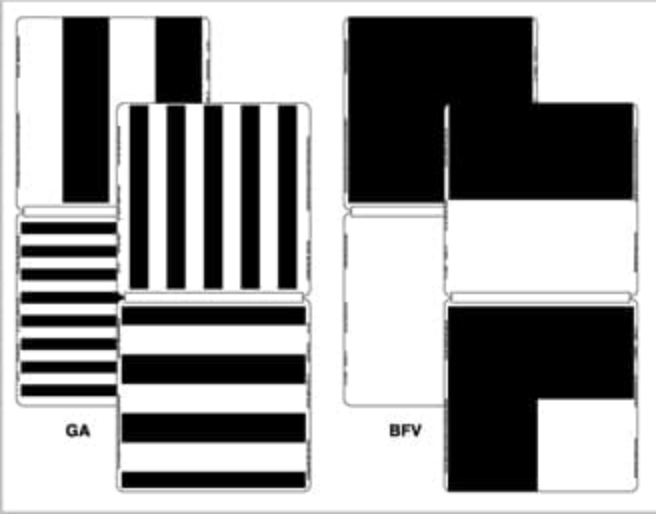
The genuine BRVT system includes three distinct, highly calibrated card pairs designed to measure spatial parameters where standard charts fail. Each pair is constructed from two 25 cm square matte-finished cards, hinged symmetrically to provide four distinct target surfaces. The package contains a Single Tumbling E Card Pair ($100\text{M}$ to $25\text{M}$ targets), a Grating Acuity Card Pair ($200\text{M}$ to $50\text{M}$ spatial periods), and a Basic Vision Card Pair featuring quadrant white/black targets and a clean hemispheric field split.
Catalog No. 4500
40 cm (16 in.) SK Read Near Eye Chart
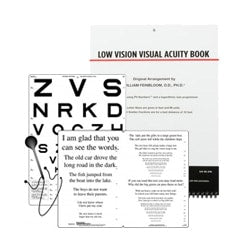
The Smith-Kettlewell Reading Test features a two-card configuration engineered to isolate reading performance gaps caused by central or paracentral scotomas. The paragraphs utilize block matrices of completely unrelated, meaning-free words to prevent cognitive guessing. Spanning text blocks from $8\text{M}$ units down to $0.4\text{M}$ units, individual rows place high-frequency words alongside single letters, causing predictable confusion patterns. Capturing the specific profile of verbalized verbal mistakes maps exactly whether a left-sided or right-sided visual field defect is encroaching into the reading track.
English: Cat No. 4201 • Italian: Cat No. 4208

%0A%0A%0A%0A%0A%0AFor%20individuals%20with%20profound%20vi...)