

Creating awareness and alleviating consequences of low-contrast sensitivity paramount to helping patients - Precision Vision
Pioneering Innovations in Contrast Sensitivity
Precision Vision® Sets the Leading Manufacturing Standard for Low- and Mixed-Contrast Diagnostics
Precision Vision® continues its pioneering status in the field of new product development, naming Contrast Sensitivity as a primary vanguard of our activity. Recognized as the world's leading manufacturer of low-contrast optotypes, we earn this status by engineering our testing media to the highest physical metrics—in some cases cutting generally accepted manufacturing tolerance thresholds in half.
At initial calibration and throughout every continuous production run, we verify process accuracy to ensure that all charts within a lot, and from lot-to-lot, are perfectly uniform. This meticulous scrutiny ensures reliable, repeatable data sets worthy of deployment in general practice, academic research, and international clinical trials.
The "Big Picture" in Visual Health
A routine physical check-up carefully evaluates internal metrics like blood pressure and heart rate. Similarly, standard eye exams screen for glaucoma or macular degeneration alongside traditional high-contrast visual acuity rows. While essential, high-contrast letter lines fail to capture a patient's complete functional capability under real-world conditions, leaving a critical diagnostic gap that only low-contrast screening can satisfy.
“While visual acuity measures how far down someone can read on a letter chart, it’s only a partial predictor of how vision serves a person during Activities of Daily Living (ADL). Most things we look at every day have far less contrast than black letters on a clean white background. For predicting real-world human function, a low-contrast vision test is a vastly superior metric.”
– Dr. August Colenbrander
Affiliate Senior Scientist • Smith-Kettlewell Eye Research Institute
Alleviating Functional Consequences through Vision Rehabilitation
Modern clinicians are traditionally trained to focus on identifying the biological cause of an ocular condition rather than evaluating its practical consequences on patient capability, which explains why contrast sensitivity metrics are frequently omitted from standard lane routines. When a patient's vision degrades due to advanced cataracts or a retinal anomaly, an ophthalmologist's immediate instinct is pathology isolation. While vital, identifying structural damage is not enough to alleviate the functional daily limitations a patient experiences.
“Patients don't just want a diagnosis; they want functional solutions. The foundational premise of vision rehabilitation dictates that we are less concerned with how a patient arrived at a visual deficiency, and far more focused on what the patient can do to actively improve their independent situation going forward,” stated Dr. Colenbrander. To drive this, he strongly advocates for broad clinical adoption of rapid, demonstrative mixed-contrast eye charts.
By positioning high-contrast and low-contrast words, letters, or shapes side-by-side within a single target card, mixed-contrast formats guarantee that both sets of optotypes maintain identical physical distances and uniform face illumination. This absolute spatial consistency maximizes testing accuracy while significantly shortening examination times for the patient and clinician.
Quantifying Real-World Hazards
Once a contrast deficit is diagnosed, practitioners can immediately upgrade a patient's independence by introducing concrete modifications, such as focused LED task lamps or high-illumination magnifiers. Dr. Colenbrander issues a firm warning regarding the hidden dangers of undetected contrast loss, particularly during night driving.
Faced with a dark-against-dark landscape, a driver with compromised contrast processing will fail to resolve a pedestrian crossing a dimly lit street, as the scene lacks the sharp borders required for rapid neural detection. In our gadget-driven culture, consumers often assume a high-tech device is required to resolve a limitation. In reality, diagnostic awareness is frequently the most powerful intervention. Revealing the explicit boundaries of a patient's contrast deficit forewarns them, allowing them to adapt their behavior and avoid catastrophic events, like tumbling over an unshaded curb.
Helen's Story: Regaining Autonomy
Helen, an 87-year-old woman navigating advanced macular degeneration, presented with severe anxiety regarding her inability to safely manage her own essential medications and those of her pet. She described herself as increasingly clumsy, regularly spilling hot liquids when pouring and injuring her fingers during kitchen meal preparation. Furthermore, she had surrendered her financial management to her son due to an inability to safely align checks or read envelope tracking lines.
While her high-contrast visual acuity rows remained stable, specialized testing uncovered a profound loss in contrast sensitivity thresholds. Her low-vision rehabilitation program focused on immediate high-contrast adaptations: deploying deep black towels beneath white pill bottles, marking her pet's dish base with high-contrast borders, and introducing black-and-white cutting surfaces to secure kitchen workspace boundaries. Backed by high-contrast check registers and alignment guides, Helen restored her independent lifestyle, noting: “Now I have my life back!”
– Submitted by Marilee Walker, OTR/L, Sacramento, CA
Colenbrander Mixed Contrast Chart
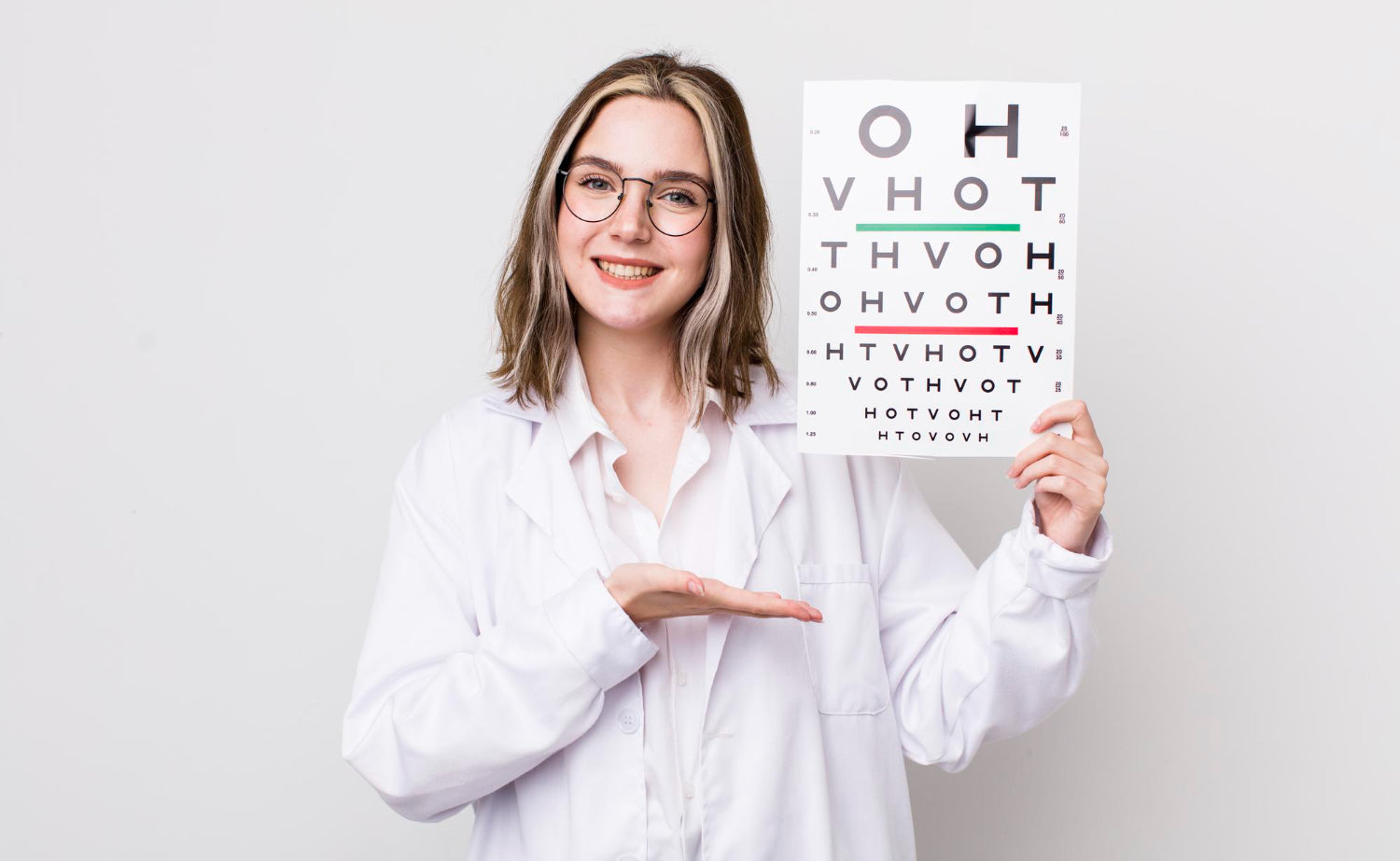
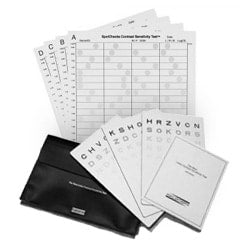
The genuine Colenbrander Mixed Contrast Chart integrates side-by-side columns of crisp pure black text lines positioned directly against a faded 20% Weber (11% Michelson) low-contrast target profile. Exact visual acuity grading values are indexed along the side margins to support testing at both 1-meter and 2.5-meter viewing distances, featuring continuous conversions for Visual Acuity Scores (VAS), Snellen notations, and metric M-units.
Bailey-Lovie Chart Set
This clinical set features two durable panels ($21 \times 24\text{ inches} \ / \ 53 \times 60\text{ cm}$), each designed with a gold-standard high-contrast logMAR layout on one side and a corresponding 18% Weber (10% Michelson) low-contrast calibration line on the reverse. Documenting the difference in total letters identified between the high and low panels delivers a precise, reliable measure of the slope of the patient's Contrast Sensitivity Function.
Upcoming Scientific Symposia & Tradeshows
Come visit our technical representatives live on the exhibition floor to experience hardware demonstrations and view our uncompromised calibration standards firsthand:
| ARVO | May 3–6, 2009 • Ft. Lauderdale, FL Booth 518 |
| AACO | May 28–30, 2009 • Chicago, IL |
| NASN | June 25–26, 2009 • Boston, MA Booth 503 |
Share Your Clinical Case Work
Precision Vision® wants to hear from our global network of eye care professionals. Tell us how your team is actively impacting low-vision rehabilitation paradigms within your community. Do you have an insightful patient outcome story or unique research application involving a Precision Vision® product line? Connect with our editorial desk today.
Submit Case Story to Editorial Desk