



December, 2019- Arabic Continuous Text Near Visual Acuity
Precision Vision Launches BAL Chart
The First Standardized Arabic Continuous Text Reading Acuity Matrix for Low Vision Rehabilitation
Bridging a Critical Diagnostic Gap
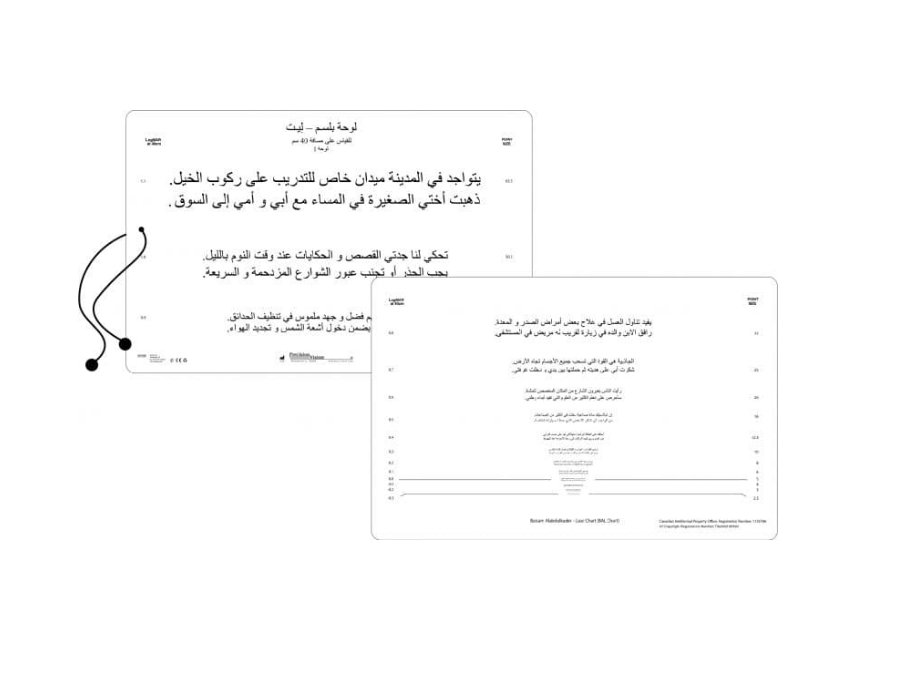
Precision Vision has announced the official availability of the Balsam Alabdulkader-Leat (BAL) chart—a calibrated continuous text near visual acuity chart in Arabic. Engineered specifically for clinical practice and advanced academic research, this system measures exact reading speed, threshold fluency, and the smallest print legible in patients with normal vision and severe visual impairment.
The BAL chart is available in three distinct, scrambled versions to eliminate memorization bias during repeated patient evaluations. Each chart features 15 meticulously fanned print size levels labeled in both logMAR and traditional point sizes. The underlying test sentences were developed and validated at the University of Waterloo, School of Optometry and Vision Science, by Dr. Balsam Alabdulkader and Professor Susan Leat.

The BAL continuous text matrix with standardized typographic increments
“Arabic is ranked as the fourth most spoken language globally, yet there was no standardized continuous text near acuity chart available in Arabia—the BAL chart is the first standardized matrix in Arabic that will make the assessment of near vision performance truly consistent,” noted Dr. Balsam Alabdulkader of King Saud University's Optometry and Vision Sciences Department, Kingdom of Saudi Arabia.
Professor Susan Leat of the University of Waterloo, Canada, explained that scientific standardization requires text passages to be engineered and tested so that sentences maintain equal geometric length and linguistic difficulty before being arranged into a standard format.
“Defining the true print size in Arabic presented a unique challenge, as there is no structural 'x-height' equivalent for determining optotype sizing as there is for languages utilizing the Roman alphabet.”
Currently, across Arabic-speaking nations, the use of unstandardized near charts is widespread. Many have been printed loosely by individual clinics or distributed freely by eye-care companies for promotional purposes. Because these targets are not developed using strict psychophysical procedures or tested for inter-examiner reliability, they introduce immense data variability. Results fluctuate based entirely on the specific chart hanging in a particular room, making cross-border clinical trial tracking unrepeatable.
“Measuring reading acuity in a patient’s native language is a prerequisite for accurate diagnostics,” stated Ed Kopidlansky, President of Precision Vision. “It is utilized to determine the refractive power of reading additions and establishes the core baseline when calculating magnification metrics for low vision rehabilitation.”
Noteworthy Peer-Reviewed Literature Tracks:
- US National Library of Medicine (NIH/PubMed) — Toward developing a standardized Arabic continuous text reading chart
- Optometry and Vision Science (OVS) — A Standardized Arabic Reading Acuity Chart: The BAL Chart
- ResearchGate Publication Profile — Development of an Arabic Continuous Text Near Acuity Chart

Functional Continuous Text Frameworks
While isolated single-optotype charts are universally favored to lock down distance visual acuity and contrast sensitivity thresholds, continuous text paragraphs are significantly more relevant to everyday visual demand.
Continuous text cards effectively simulate realistic near-vision tasks—such as reading a column in a newspaper or following a book passage. Browse our extensive, geometrically calibrated multilingual low-vision testing inventory.
Purchase BAL Charts
Each issue we take a look at some of the most frequently asked questions that we receive and feature a regulatory Q&A below:
Q: How many distinct languages does Precision Vision manufacture across its continuous text reading chart catalog?
A: Precision Vision, Inc. proudly manufactures standardized charts in 21 distinct languages and regional dialects. This comprehensive global library ensures perfect diagnostic tracking parity across international patient populations:


