



February, 2020- February, 2020- All Eyes On 2020! Focusing On Future Eye Care Professionals!
All Eyes on 2020!
Focusing on Future Eye Care Professionals & Multidisciplinary Conversion Standards

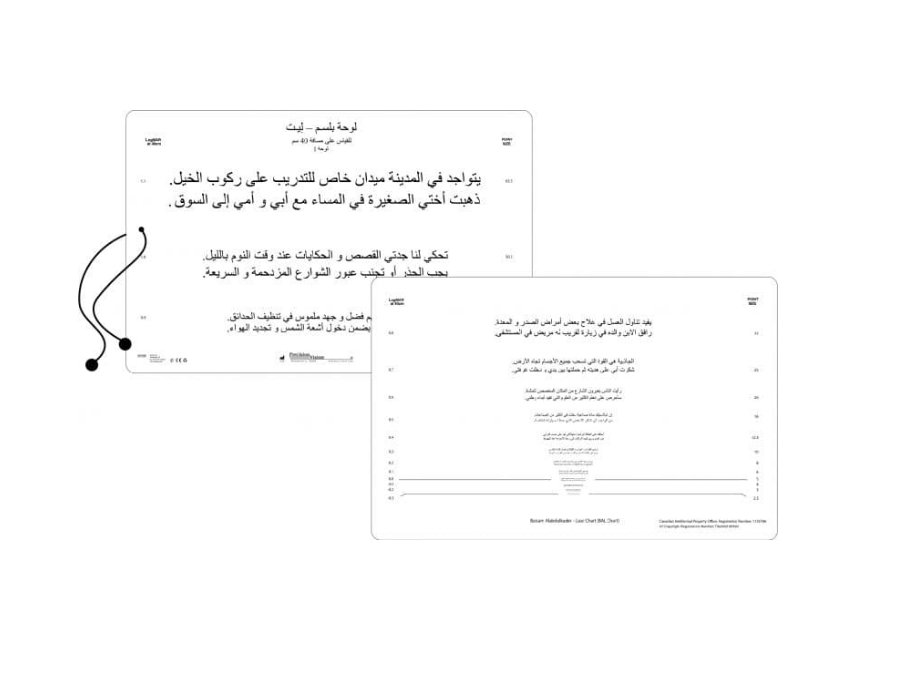
Precision Vision pocket translation matrices for logMAR, Snellen, and contrast units
Supporting Academic & Clinical Training
Precision Vision is committed to making a difference for university professors and students in vision-related studies. Students working under Dr. Nicole Ross, Associate Professor of Optometry at the New England College of Optometry (NECO), regularly utilize the visual conversion cards engineered by Precision Vision, Inc.
“The Precision Vision Contrast and Visual Acuity Conversion Cards have enhanced the students’ academic and clinical experience at NECO. The outlined format of the visual impairment categories, Snellen to logMAR acuity conversion, and Weber contrast to $\log CS$ conversion are beautifully organized. During clinical low vision course training, students utilize a variety of electronic contrast sensitivity tests. The quick conversion of those contrast results back into $\log CS$ units has been greatly appreciated when outlined in this portable card. It has received outstanding feedback from both students and faculty as a useful reference tool.” – Dr. Jeffrey Ho, OD, FAAO, Assistant Professor of Clinical Optometry
Precision Vision offers every customer clinically tested products, continual innovation, and unparalleled technical support. Throughout the month of February, we are shipping a complimentary Conversion Card with every purchase. Quickly convert contrast values, ICD-9 and ICD-10 vision loss reporting codes, and international notations with this handy, pocket-sized card.

Collaborative Visionary Architecture
Precision Vision, Inc. has proudly collaborated with Dr. August Colenbrander on many of our core visual diagnostics, optimizing the mathematical relationships embedded in current testing media.
For 25 years, Dr. Colenbrander directed the Vision Rehabilitation service at California Pacific Medical Center. He was a founding board member of the International Society for Low Vision Research and Rehabilitation (ISLRR) and represented the specialty of Vision Rehabilitation on the Advisory Committee of the International Council of Ophthalmology (ICO). Dr. Colenbrander developed many of the simple, highly effective screening tools for early detection of vision problems integrated across the current Precision Vision catalog.

Introduction to Visual Acuity Measurement
By August Colenbrander, MD
This technical blueprint is integrated across leading university optometric curricula to guide vision assessment protocols. It features dedicated sections detailing low vision rehabilitation, functional performance metrics, pediatric tracking models, and contrast threshold calibration techniques.
Read the Technical Manual
Each issue we take a look at some of the most frequently asked questions that we receive and feature a clinical Q&A below:
Q: What is defined as Normal Vision?
A: “Normal” visual acuity for healthy eyes is actually one or two lines better than the traditional 20/20 mark. In large population studies, the average visual acuity of healthy individuals does not drop to the 20/20 level until they reach 60 or 70 years of age.
Always remember that the 20/20 reference standard is an arbitrary baseline rather than the average acuity of the general population—much like how the standard unit of a foot is defined independently of the actual physical length of average human feet.