


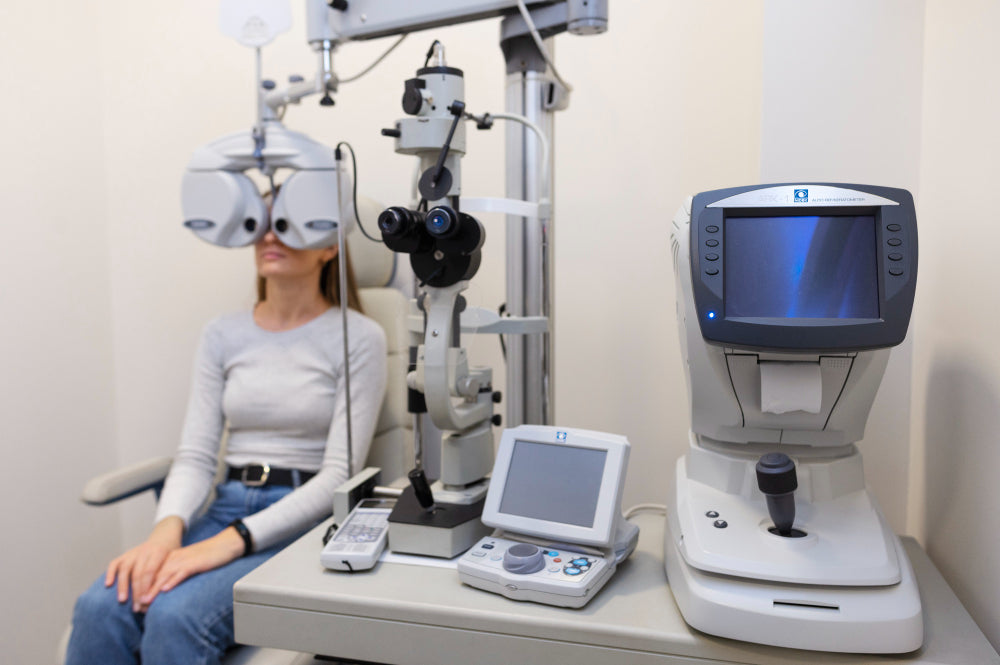



March, 2020 - The Teller Acuity Cards Are Effective in Detecting Amblyopia
Teller Acuity Cards® in Amblyopia Detection
Validating Preferential Looking Grating Thresholds Against Gold-Standard Optotype Criteria

Clinical Validation Brief: Optometry and Vision Science Publication Data
Overcoming Fixation Preference Inaccuracies
Detection of amblyopia in infants and toddlers is notoriously difficult because the current clinical standard for this age group, fixation preference, is highly inaccurate. Although grating acuity represents an alternative tracking method, historical studies of preschoolers and schoolchildren report that it is not perfectly equivalent to gold-standard optotype acuity layout formats.
This landmark paper examines whether the Teller Acuity Cards® (TAC) can detect amblyopia effectively by testing children old enough ($7.8 \pm 3.6$ years) to complete both standard optotype acuity testing and forced-choice grating evaluation side-by-side.
Read Full Study Abstract
Precision Vision is consistently chosen to work directly alongside the leading global authorities, pharmaceutical entities, and clinical researchers in the vision testing industry.
Our core manufacturing business remains strictly focused on producing the highest quality vision testing tools paired with unparalleled technical customer support. Precision Vision prides itself on serving as the de-facto gold standard in vision testing products to which all other market alternatives are compared.
Browse Gold Standard Products
AAPOS Meeting • Booth T41 Come see our team live to request an objective software demonstration and pick up technical samples of the revolutionary SpotChecks® Contrast Sensitivity Test!
Click below to download the official floor plan mapping out exhibitor booth tracking lines.
Get Exhibition Hall MapQ: What is the best way to prep a non-verbal or preliterate pediatric patient for optotype recognition?
A: Managing environment boundaries is critical. Always configure the evaluation zone completely ahead of schedule. The testing lane must remain uniformly illuminated and carefully arranged to eliminate structural distractions. If testing in an open clinical space, deploy movable partitions to isolate the child's field of view.
Before introducing targets, explain the mechanism to the child in an accessible, engaging manner (e.g., framing it as a fun game or contest to see what each individual eye can resolve). Direct the child to identify and name the shapes on a large sample 5-symbol response key card. If they struggle with initial naming conventions, offer consistent, concrete semantic hooks: star, circle/ball, square/box, house/arrow, or apple/heart.
Ensure they maintain identical, predictable labels across lines so you can accurately score structural recognition. As optotypes drop in size, children may naturally switch to diminutive variations (e.g., calling a target a "berry" or "ant house"); simply request matching actions to verify their answers. For highly hesitant or non-verbal subjects, utilize a forced-choice matching drill: direct them to point to the corresponding target on their handheld matching card that matches the isolated distant symbol shown on the lane screen. Always seed the protocol starting with massive, easily identifiable optotypes to establish trust and momentum, keeping the interaction light and positive.


