



EyeOnVision February, 2021 - Testing for Low Vision
Vision Rehabilitation is Part of AMD Care
Bridging Medical Interventions with the Functional Consequences of Macular Degeneration
Dr. August Colenbrander –
Age-related macular degeneration (AMD) does not just affect the retina. It severely affects people’s lives. Paying attention to this aspect will only become more important as the population ages and more otherwise healthy individuals become affected.
This paper discusses the vital need for multi-disciplinary teamwork to overcome the critical division between standard medical care, which addresses the physiological causes of AMD, and comprehensive rehabilitative care, which systematically addresses its daily functional consequences.
Read Full Paper
Berkeley Rudimentary Vision Test (BRVT) – Originating from Blind Cricket Competitions
For people with extremely poor vision, assessing visual acuity in the past has been mostly a matter of subjective analysis. Once a patient can no longer resolve the top line of a traditional Snellen chart, clinicians routinely resort to categorizing residual sight with loose, unstandardized definitions like counting fingers (CF), hand motion (HM), or light perception (LP). These raw categories lack strict testing procedures, fixed lighting baselines, or uniform measurement distances.

Thanks to the work of Dr. Ian Bailey, OD, MS, FAAO, the Berkeley Rudimentary Vision Test overrides these obstacles to deliver a reliable, highly efficient metric for spatial vision. Under continuous refinement since 2007, Dr. Bailey and his team engineered the BRVT to satisfy a glaring global requirement: the industry needed a standardized, repeatable protocol to systematically capture measurements when clinical acuity drops beyond the physical scaling limits of traditional letter charts.
The design was conceptualized after the World Blind Cricket Council (WBCC) requested Dr. Bailey's expertise on an advisory committee reviewing the parameters used to classify athlete impairment tiers fairly. He initially designed a digital PowerPoint matrix to mathematically isolate and quantify acuity milestones. Over the subsequent year, the clinic group used this framework to map low-vision capabilities.
“We quickly realized we needed something that didn’t rely upon a computer display, localized operating systems, or electrical power—something we could deploy in advanced metropolitan multi-center lanes as seamlessly as in rural, developing-world fields,” Dr. Bailey noted.
Collaborating alongside Dr. Hasan Minto, OD, FAAO, and Dr. A. Jonathan Jackson, PhD, MCOptom, FAAO, the panel compressed these parameters into a highly portable set of three specialized card pairs: an isolated Single Tumbling E pair, a Square-Wave Grating Acuity pair, and a Basic Vision Function classification pair. The operational mechanics are beautifully simple, objective, and rigidly standardized.

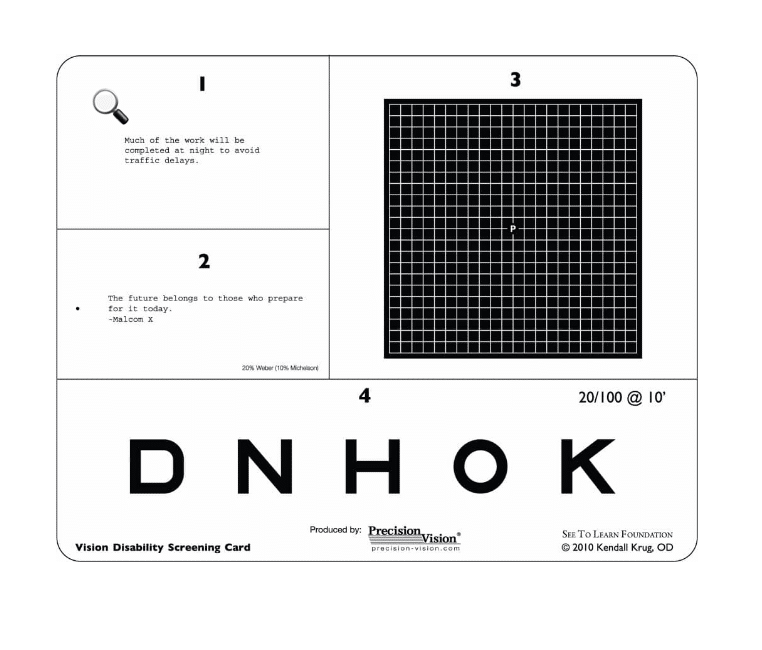
The Krug Vision Disability Screening Card
The Vision Disability Screening Card was engineered specifically for agency evaluation professionals, occupational rehabilitators, and primary care physicians to efficiently identify functional near-vision deficits. It targets loss affecting essential activities of daily living, specifically tracking a patient's capacity to resolve standard 1M newsprint targets.
Crucially, it embeds a dedicated row of calibrated 20/100 distance vision optotypes, providing a rapid checkpoint to screen for legal blindness under updated federal criteria. Manufactured and found exclusively through Precision Vision channels.
See More Details
MNRead Acuity Charts
MNRead Acuity Charts are continuous-text reading cards designed for exhaustive functional and low-vision diagnostics. Available in **Dutch, German, French, English, and Spanish**, each chart features 19 precisely calibrated text passages. This enables practitioners to determine reading acuity thresholds, maximum reading speed limits, and critical print size targets.
Ideal for academic research, pediatric evaluations, and special education assessments, these charts streamline low-vision care. They provide objective metrics to guide the prescription of optical correctors, including handheld lenses, spectrally filtered illumination, or lens-mounted magnification systems.
Q: Can you tell me which measurement of visual function is most likely affected by AMD?
A: Our team put this question directly to our trusted industry specialist and pioneer, Dr. August Colenbrander. Below is his structural analysis:
“I assume that the motivation behind this question is the desire to detect early stages of AMD as effectively as possible before the patient is recognized as a known case of AMD. Early detection is desirable because early treatments are generally more effective. The answer to the early detection question is that there is no single parameter that will always be most effective. I will discuss several options...”
Got a question for us? – Click Here!