


PV News - January 2010 - Letter Charts vs. Reading Tests - Precision Vision
The Evolution of Near-Vision Psychophysics
Precision Vision® Selected as Exclusive Licensed Manufacturer and Distributor for MNRead Cards Worldwide
From Jaeger Fractions to Logarithmic Progressions
Vision assessment holds a deep, winding legacy. Its modern evolution accelerated during the mid-19th century as ophthalmology emerged as medicine's premier organ-based specialty. While contemporary practitioners intuitively look to wall optotypes, the initial science began not with letter charts, but with continuous reading text.
In 1854, Eduard Jaeger in Vienna printed a series of reading samples as a clinical supplement to his text on cataract surgery. They found immediate success, yet because these **"Jaeger numbers"** were tied to unique reference fonts from the Vienna State Printing House, reproducing them elsewhere with local typeface stocks proved impossible. This layout legacy explains the extreme variability among Jaeger cards today: in a random audit of 20 current charts, four labeled standard newsprint ($1\text{M}$ unit) as J2, while four others indexed the exact same size as J8. Jaeger never engineered a distance chart.
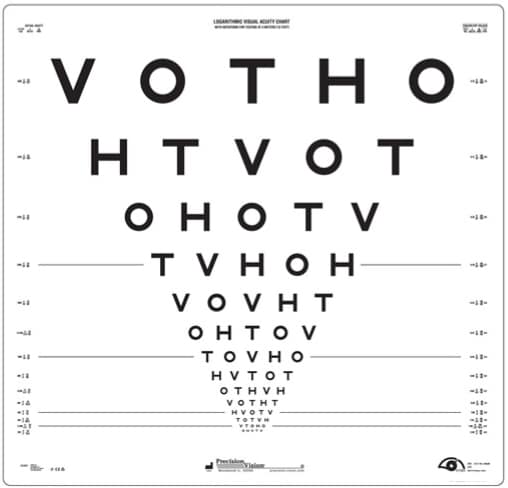
Standardization arrived in 1862 when Herman Snellen published his tests in Utrecht, introducing the physical measurement ($5\text{ minutes of arc}$) to define **visual acuity**. However, Snellen utilized large geometric steps for low vision and micro-steps for high acuity. It was John Green of St. Louis who, following a fellowship with Snellen in 1868, proposed a uniform **logarithmic progression**. Green was a century too early; his math was largely ignored until the National Eye Institute mandated the ETDRS logMAR format in 1982.
MNRead Manufacturing Pipeline
Precision Vision® is proud to announce that we are now officially the **exclusive licensed global manufacturer and distributor of the English MNRead Reading Cards**, working under direct license from Dr. Gordon Legge and his visual psychophysics team at the **University of Minnesota**.
This exclusive core partnership sits alongside our ongoing engineering design work with world-renowned vision scientists, including **Dr. August Colenbrander** (Mixed Contrast™ eye charts) and **Dr. Wolfgang Radner** (highly standardized sentence matrices).
Letter Charts vs. Reading Tests: Measuring Eye vs. Person Function
Standardized letter charts are specifically designed to isolate and test the absolute refracting power of the ocular media. Because they are structurally simple and fast to run, they have historically been preferred for quick lane tracking. However, as the focus of contemporary eye care expands from simply tracking how the **EYE** functions to how the **PERSON** functions within their environment, continuous-text reading tests have captured priority attention.
Modern reading tests do not simply log the smallest line a patient can read. Instead, they actively track **reading speed (words per minute)** and chart its exact relationship to decreasing print size. To safeguard scientific validity, every single paragraph on contemporary cards is mathematically balanced to hold the exact same word count and character length, giving clinicians a flawless window into real-world visual stamina.
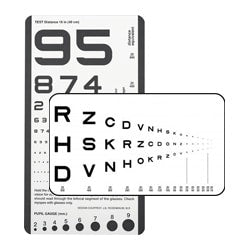
Sloan Two-Sided ETDRS Near Point Chart
This double-sided near chart features highly calibrated Sloan optotypes, matching the official ETDRS 2000 Series (Charts 1 and 2) converted into a handheld near-vision format. Calibrated explicitly for a 40 cm working distance, it includes an attached focal cord to guarantee precise testing metrics. The chart layout displays multiple acuity notations (logMAR, Snellen feet/meters, and Decimal notations) to support diverse recording preferences across standard clinical research lanes.
Colenbrander Low Vision Reading Card Set
Designed to capture functional daily parameters, this card set utilizes proportionally spaced sentences to simulate real-world tasks like reading newsprint. Continuous text evaluation is a critical diagnostic step, as it unmasks the creeping effects of early para-central scotomas (visual field defects) that often slip past traditional single-letter distance charts unnoticed.
Avoid Shipping Overhead: Pick Up Live at Shows
Precision Vision® maintains an active presentation pavilion across major ophthalmic trade exhibitions. If you are attending an upcoming annual meeting and want to entirely bypass freight shipping costs or warehouse delays, our logistics department will gladly hand-deliver portable charts and reading card sets straight to you. Place your order through our web portal or call us directly at **800-772-9211**, and let us know which show floor should hold your equipment package:

Share Your Clinical Case History
Precision Vision® values the unique operational insights of our global user network. Tell us how your diagnostic team or research group is deploying our calibrated reading cards to enhance patient vision paths. If you have an insightful study observation, custom lane template, or field validation story to share involving our products, reach out to our tracking desk today to submit your entry for a future newsletter feature.