



PV News - February 2010 - Reading Cards Compared - Precision Vision
The Global Standards for Reading Acuity
Precision Vision® Analyzes the Design, Architecture, and Clinical Applications of the Top Three Reading Systems
Precision Vision® stands as the undisputed global leader in reading card production and near vision psychophysics. By collaborating directly with elite clinical researchers, we proudly print, validate, and distribute the industry's top three reading chart platforms: **MNread**, **Colenbrander**, and **RADNER**. While each system leverages continuous text blocks to simulate daily activities, their structural design properties, optotype typography, and contrast matrices are optimized for distinct clinical pathways.
MNread Charts
Developed in 1993 by Gordon Legge, PhD, and his research staff, MNread was the pioneer platform to introduce a strict logarithmic progression of print sizes to near vision diagnostics. This system features text blocks scaling from $8\text{M}$ down to $0.16\text{M}$ ($20/400$ to $20/6.3$ equivalents at 40 cm).
To ensure exceptional field longevity, Precision Vision® manufactures these charts with a durable, non-glare satin finish on the printed layer. The system is available across multiple global translation profiles—including French, Portuguese, Greek, Swedish, Italian, and Japanese—with alternative text iterations continuously engineered to eliminate chart learning effects during repetitive multi-visit clinical trials.
Colenbrander Cards
Engineered across a multi-year validation tracking block (1994–2008) by August Colenbrander, MD, this highly versatile series contains specialized targets for both standard optometric practices and advanced low vision rehabilitation. The dedicated Low Vision card sets include a physical measuring ruler backed by a diopter scale, permitting accurate testing at any custom working distance, with optotypes scaling up to a massive $10\text{M}$ ($20/2000$ at 10 cm).
Standard variants utilize calibrated attachment cords to lock in an uncompromised 40 cm tracking line, extending down to a sharp $0.2\text{M}$ ($20/10$). Printed on durable, entirely washable polymer sheets, these cards are available in 11 international languages.
RADNER Charts
Representing the latest core acquisition to our professional near vision portfolio, the RADNER Reading Charts system was developed in Vienna by ophthalmologist Wolfgang Radner, MD. The platform was built via an intensive interdisciplinary collaboration uniting eye surgeons, linguists, psychologists, physicists, and statisticians.
Bound as a clean, letter-sized testing booklet, this tool houses three standardized text cards alongside dedicated numeric rows and calibrated Landolt ring matrices. The RADNER sentences are uniquely celebrated for delivering the most mathematically and grammatically standardized sentence optotypes in the world, with print sizes ranging from $6.3\text{M}$ to $0.25\text{M}$ ($20/320$ to $20/12.5$ at 40 cm).
Methodological Discrepancies Across Reading Charts
Selecting the ideal near-vision card requires mapping your practice goals against the distinct parameters of each testing system. While both the MNread and Colenbrander series utilize a classic **Times New Roman font** to closely replicate the proportional spacing of daily newspapers or books, the RADNER series breaks away by employing a clean, geometric **sans-serif typeface** to mirror the optotype structure of distance lane charts.
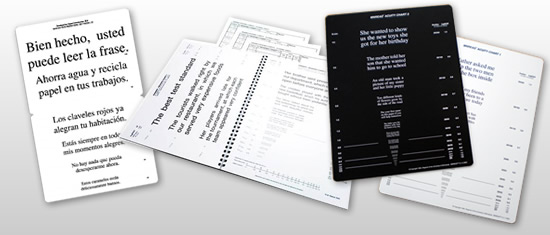
Colenbrander Continuous Text Near Vision Card
Evaluating patient sight with continuous paragraph strands rather than isolated single-letter lines is crucial for understanding a patient's true functional capacity. Because reading structured text mirrors daily tasks like absorbing newspapers or sorting bills, it forms the logical foundation for calculating near magnification adjustments and customized prescription lenses. The calibrated $\text{M}$ unit print sizes guarantee pristine data accuracy across any reading distance.
MNRead Chart 1 – Reverse Contrast Series
Featuring crisp white text arranged on a deep black background, this specialized chart incorporates meticulous sentence variations across its card rows to block testing memorization. The platform delivers integrated scoring charts and preferred clinical calculators to quickly measure reading speed, alongside conversion algorithms for testing at non-standard viewing distances.
Avoid Shipping Overhead: Pick Up Live at Shows
Precision Vision® maintains an active presentation presence across major global ophthalmic symposia. If you are attending an upcoming event and want to bypass freight shipping costs and international warehouse delays, we are happy to hand-deliver portable charts and booklet tests directly to you. Simply place your order online or contact our logistics desk at **800-772-9211**, and notify our staff which tradeshow floor should hold your equipment package:

Share Your Clinical Case History
Precision Vision® values the unique operational insights of our global user network. Tell us how your diagnostic team or research group is deploying our calibrated reading cards to enhance patient vision paths. If you have an insightful study observation, custom lane template, or field validation story to share involving our products, reach out to our tracking desk today to submit your entry for a future newsletter feature.