



PV News - September 2010 - Precision Vision Introduces the New SK Read Testing Chart - Precision Vision
Exposing Retinal Scotomas in Reading Activity
Precision Vision® Introduces the SK Read Test to Unmask Central Field Blind Spots
At this exact second, you are performing a basic visual tracking skill most take entirely for granted: reading. Millions globally struggle with this task, not from a lack of literacy, but because age-related macular degeneration (AMD) or neurological pathologies have compromised their central fields.
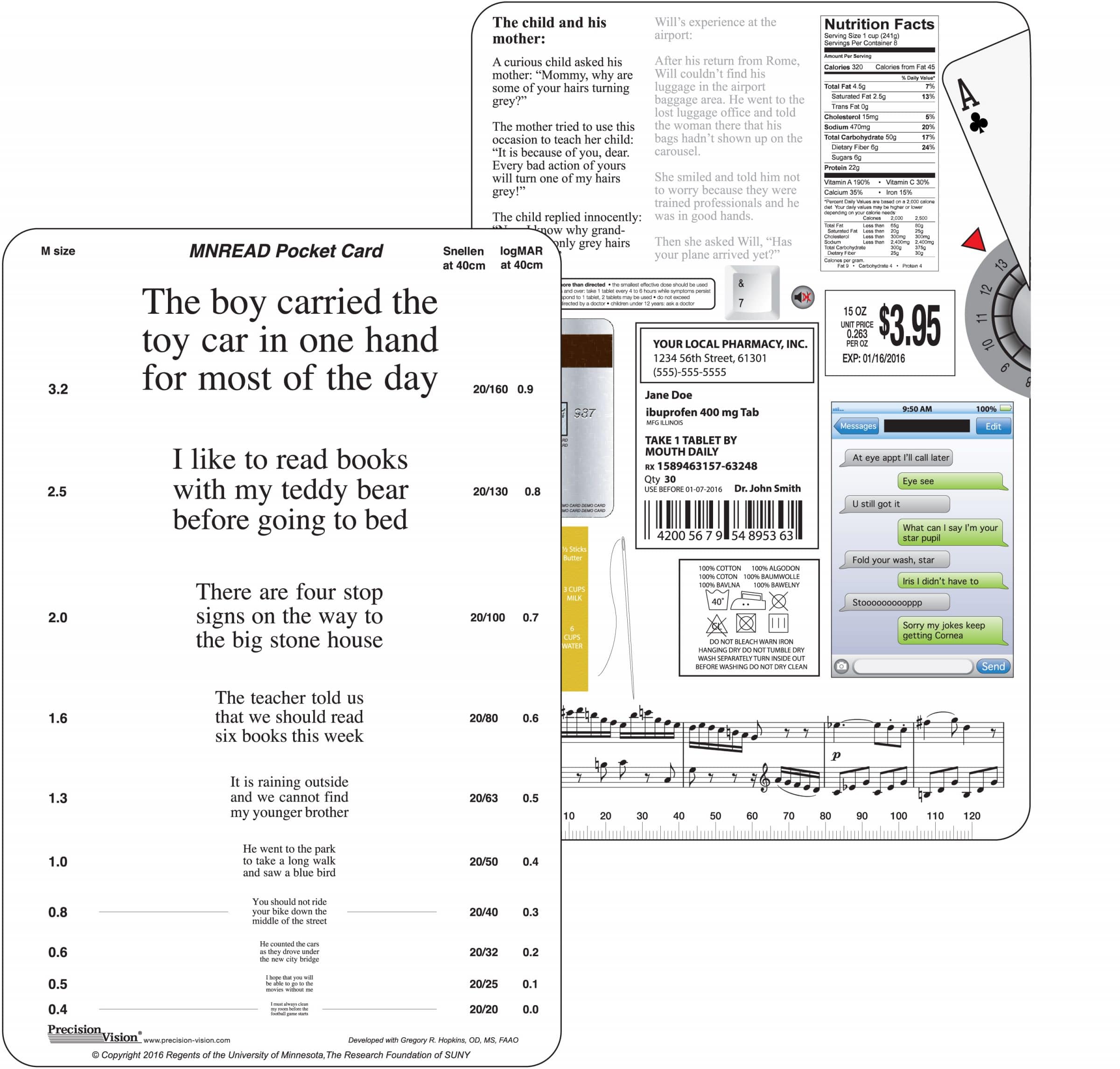
Traditional charts like the MN Read excel at mapping optimal text size vs. raw reading speed by utilizing full sentences (e.g., "My father takes me to school every day..."). However, these contextual frameworks present a major diagnostic blind spot: perceptual completion.
The human brain is remarkably adept at filling in missing characters. If a patient’s macular scotoma eclipses a letter, they will scan past it until the sentence contextually sounds right. The patient unconsciously "cheats" by guessing, meaning their blind spots go completely undetected. This oversight explains why traditional magnifiers frequently fail; patients remain entirely unaware of the spatial "black holes" corrupting their field of view.
“Reading is best assessed by actual reading mechanics, not simply recognizing isolated characters on a distant wall chart. Approximately 90% of AMD patients seen in low-vision rehabilitation manifest central scotomas. The SK Read strips away contextual syntax clues, forcing the eye to reveal its true functional boundaries under real-world conditions.”
– Donald C. Fletcher, MD
Smith-Kettlewell Eye Research Institute
Stripping Syntax to Track Real-World Macular Integrity
Engineered to mimic the exact structural size, logarithmic progression, and administration layout of standard reading cards, the **SK Read Test** introduces a single, critical shift: it utilizes entirely random, non-contextual word blocks and single letters.
Because this grouping forms no coherent narrative, guessing is mathematically blocked. If a right-sided or left-sided scotoma causes the initial letter of a word to vanish, a patient will read the remaining fragment out loud without realizing an error was made. For instance, if the "g" in gold disappears, the patient verbalizes "old"; if the "e" in theme drops, they read "them." Within mere minutes, practitioners can accurately isolate scotoma geography based on these predictable verbal mistakes.
Diagnostic Performance Matrix
| Feature Benefit | Clinical Operational Outcome |
|---|---|
| Elevated Error Capture | Patients commit 20 to 30 times more verbal errors on the SK Read than on contextual tests, instantly highlighting macular defects. |
| Refractive Independence | Provides a clean baseline evaluation completely independent of initial trial magnification parameters. |
| Acuity Deficit Sensitivity | Identifies severe reading friction in patients holding solid 20/40 or 20/60 distance scores, proving traditional distance metrics are insufficient. |
| Therapeutic Monitoring | While an OCT measures structural macular thickness, the SK Read tests functional integrity—verifying if a treatment preserved enough macular span to read actual words. |
The SK Read Test Card Set
Engineered to evaluate the reading performance of English-speaking adults facing central field anomalies. Text blocks scale precisely in standard LogMAR progressions from 8M units down to 0.4M units. Each paragraph block integrates single letters alongside carefully selected high-frequency vocabulary matrices to trigger predictable confusion profiles.
An affordable baseline addition for any lane, the SK Read chart set delivers rapid, clear validation of structural defects within minutes.
Colenbrander Near, Intermediate & Computer Chart Suite
Traditional high-contrast testing charts capture only a narrow slice of a patient's visual capacity. Evaluating low-contrast thresholds is equally critical for everyday functioning, given that most real-world objects lack black-on-white edges and span various intermediate viewing working planes.
- Designed by renowned researcher Dr. August Colenbrander
- Calibrated for 40 cm (16 in), 63 cm (25 in), and 100 cm (40 in) distances
- Integrates a 10% calibrated Low Contrast Sensitivity level with Acuity lines
- Measures 8.5" x 11" — includes exhaustive instructions and evaluation sheets
Avoid Shipping Delays: Pick Up at Tradeshows
Precision Vision regularly exhibits across major clinical conventions. If you are attending an upcoming meeting and want to bypass freight overhead, we are happy to hand-deliver compact testing tools directly to you. Place your order online or connect with our desk at **800-772-9211**, and specify which show floor should hold your equipment package.

Share Your Clinical Workflow Stories
Precision Vision® wants to spotlight your contributions to the field. Tell us how your specialized care team is utilizing our calibrated metrics to transform low-vision outcomes. Do you have an interesting workflow success or patient history to share involving our product catalog? Connect with our tracking desk and your narrative could be featured in a future global bulletin.