



Precision Vision and ETDRS – ETDRS Charts, Illuminator cabinet – Precision Vision
The Genesis of the ETDRS Standard
How Precision Vision® Partnered with the NIH and National Eye Institute to Forge Global Ophthalmic Benchmarks
Nearly three decades ago, a monumental visual science paradigm shifted the entire diagnostic trajectory of retinal care. The **Early Treatment Diabetic Retinopathy Study (ETDRS)**—a landmark, randomized multi-center clinical trial—was initiated to objectively evaluate the long-term therapeutic risks and benefits of argon laser photocoagulation and aspirin regimens across a massive registry of 3,711 patients presenting with non-proliferative or early proliferative diabetic retinopathy.
Before this international investigation could gather its baseline data, a critical problem emerged: legacy visual acuity matrices, including historical Snellen fractions and basic Sloan letter charts, lacked the rigid geometric and photometric standardization required to guarantee repeatable test-retest measurements across dozens of independent clinical centers.
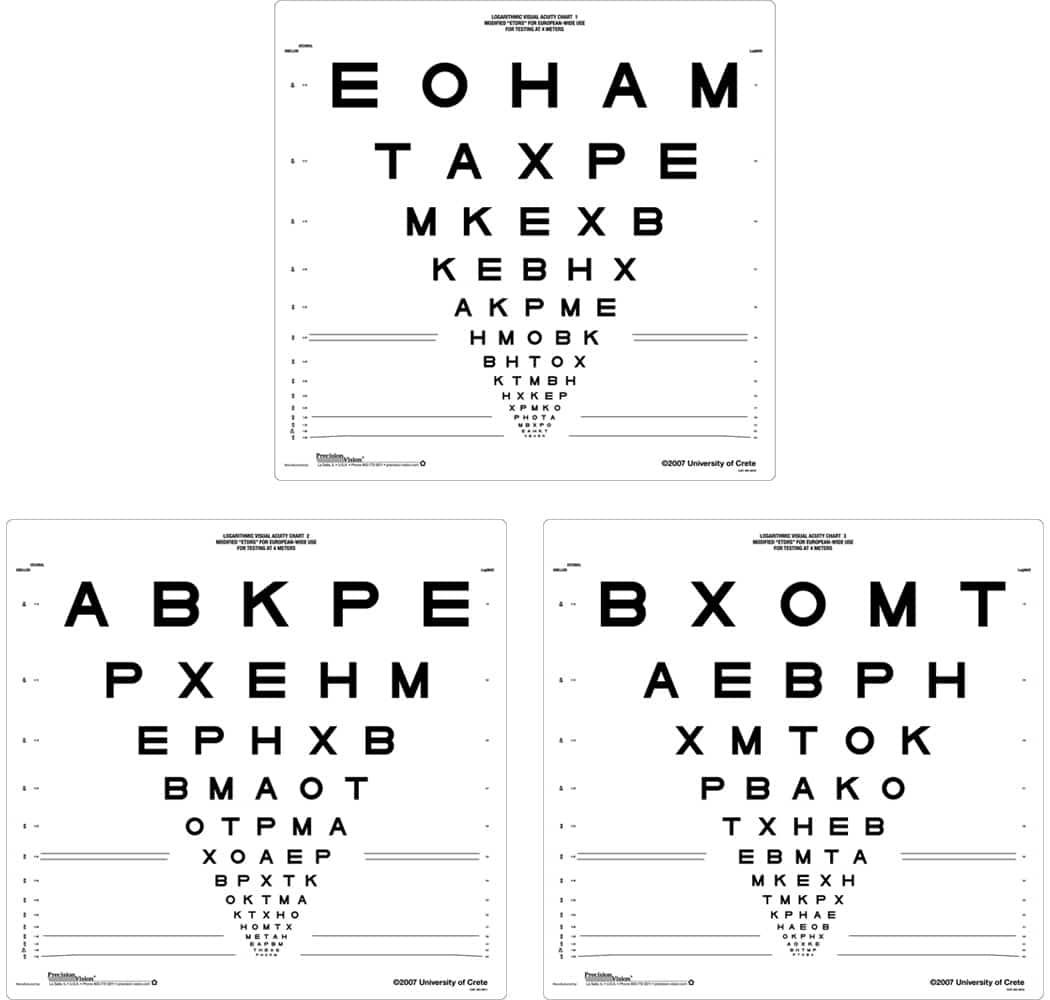
Engineering the LogMAR Matrix: Beginning in 1982, vision pioneers **Frederick L. Ferris III, M.D., Aaron Kassoff, M.D., George H. Bresnick, M.D., and Ian Bailey, O.D.**, published a revolutionary layout framework in the American Journal of Ophthalmology. This design established the foundational logMAR eye charts and uniform retro-illuminated enclosures that have since become mandated as the absolute global "Gold Standard" for visual acuity validation.
“I remember the first cabinet. It was a big, wooden contraption with fluorescent tubes positioned awkwardly in front of the chart face—it consumed an immense amount of floor space. There simply was no commercially viable back-lighted cabinet in existence until Ed Kopidlansky Sr. at Precision Vision took on the manufacturing challenge.”
– Dr. August Colenbrander
“Originally, we sketched out our charts by hand in the NIH print shop, using staff artists to render the letter strokes exactly. But we were researchers, not optical printers. Ed Kopidlansky Sr. was uniquely fascinated by the geometric science of optotype layout. He worked closely with us through numerous iterations in the early 1980s, duplicating our exact constraints with absolute fidelity.”
– Dr. Frederick L. Ferris III
Eliminating Ocular Hot Spots: Uniform Retro-Illumination Architecture
Once the proportional spacing mechanics of the characters were locked, the development loop shifted toward the lighting physics. To achieve perfect, un-skewed diagnostic results, chart luminance had to remain flawlessly homogeneous across the entire tracking panel.
This layout vastly compressed the space required in a traditional eye lane while standardizing visual fields globally. Moving forward into modern optometric spaces, our research and development plant is actively constructing the next-generation evolution of this definitive equipment. This incoming model transitions the retro-illuminated core to a specialized LED solid-state panel. This upgrade reduces cabinet depth to a sleek fraction of the original box profile, drastically diminishing logistics costs and office real estate requirements while matching the exact photopic criteria of the original study.
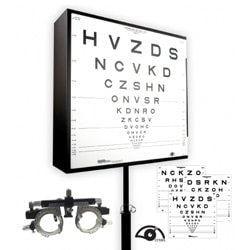
The Original ETDRS Retro-Illuminated Cabinet
The benchmark testing box utilized extensively across global clinical research trails for over 25 years. Features an integrated rear-mounted storage slot for rapid chart management. It can be wall-mounted or attached to an optional 5-leg mobile caster base. Fully approved and recommended by the FDA and National Eye Institute, it provides rock-solid, uniform lighting calibrated for all $62 \times 65\text{ cm}$ ($24.5 \times 25.5\text{ in.}$) visual acuity targets.
Original Series ETDRS Chart Panels
The only standardized visual chart format accepted globally by the National Eye Institute for high-accuracy clinical trials. Built using a strict geometric sizing progression from line to line, each horizontal tier maintains perfectly balanced reading difficulty. Engineered specifically for complex low-vision evaluations and multi-center drug studies where accurate, repeatable thresholds are an absolute regulatory mandate.
Share Your Clinical Validation Success Stories
Precision Vision® values the unique operational insights generated across our global network of eye care professionals. Tell us how your diagnostic team or research group leverages our standard ETDRS instruments to achieve perfect data continuity. If you have an insightful study highlight or validation success story to share involving our products, connect with our editors today.
Submit Case Narrative to Editorial Desk