



PV News - June 2009 - Rabin Test for Contrast Sensitivity - Precision Vision
Advancing Contrast Sensitivity Testing
Precision Vision® Modernizes Low-Contrast Diagnostics with Light-Independent Rabin Testing Matrices
As the summer months prompt extended outdoor activities, eye care professionals hold a prime seasonal window to address **contrast sensitivity (CS) deficiencies** across patient populations. While standard high-contrast visual acuity is an essential baseline, it maps poorly to real-world visual survival skills—such as an un-aided driver attempting to resolve a dimly lit pedestrian stepping onto a dark asphalt crossing at dusk.
For decades, the standard Pelli-Robson chart reigned unchallenged as the clinical gold standard for contrast isolation. Yet, the Pelli-Robson layout harbors a major operational bottleneck: it demands meticulous, manually verified ambient room illumination ($85\text{ cd/m}^2$) to prevent variable lux levels from corrupting test-retest reproducibility scores.
Bypassing Ambient Constraints: The newly developed Rabin Contrast Sensitivity Test eliminates room illumination volatility completely. By nesting highly calibrated optotype rows inside a dedicated, compact internal illuminator cabinet, Precision Vision® empowers clinics, schools, and field labs to execute error-free CS evaluations in any environmental setting, regardless of erratic ambient overhead light arrays.
Emory University Comparative Study
An in-house, multi-cohort trial evaluating older adults and low-vision subjects has officially validated the Rabin chart's statistical behavior.
“We historically assumed Pelli-Robson was the unshakeable benchmark. Our comparative analysis reveals that the Rabin Test yields identical diagnostic outcomes while delivering unmatched lane agility.”
– Dr. Ronald Schuchard
Director, Atlanta VA RR&D Center
Structural Discrepancies: Pelli-Robson vs. Rabin Log CS Progression
The underlying structural configuration of the Rabin system introduces key clinical advantages over classic platforms. While the Pelli-Robson chart employs a single, uniform giant letter size ($0.5\text{ logMAR}$ equivalents at 1 meter) across the entire target area—altering contrast steps after every group of three letters—the Rabin chart aligns closely with standard **ETDRS distance visual acuity formats**.
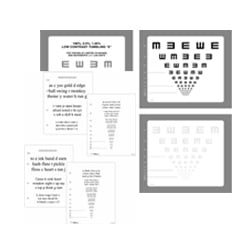
For highly demanding validation paths, Precision Vision® also manufactures the specialized **Rabin Super Vision Test**, an asset relied upon extensively by the **U.S. Armed Forces** to screen fighter pilots and elite operators. This dual-purpose panel prints a high-contrast visual acuity matrix on the top hemisphere (scaling down to a micro $20/5$ line on a logMAR gradient) and pairs it with eight distinct, highly calibrated contrast sensitivity steps on the bottom half. By integrating completely distinct, scrambled optotype sequences for the left and right eye, the Super Vision test entirely counters patient chart memorization shortcuts.
Rabin Contrast Sensitivity Test (Small 914 Cabinet)
Isolates subtle effects of refractive defocus, low luminance, and active glare fields. Calibrated for an exact $20/50$ Sloan letter baseline at a $4\text{ meter (13 feet)}$ viewing path. Contrast settings scale up row-by-row in uniform $0.25\text{ log steps}$. Complete clinical package includes a non-reflective soft-tipped pointer, padded scoring templates, and clear testing instructions.
Rabin CS Test Chart for Large ETDRS Cabinet
Full-sized variant tailored explicitly for seamless mounting inside our standard **Large ETDRS Backlit Illuminator Cabinet (Cat. No. 2425)**. Calibrated for $4\text{ meter}$ testing tracks utilizing a fixed $20\text{M}$ ($20/100$ equivalent) Sloan font field. Delivers exceptional test parity and log step progression tracking across high-volume ophthalmic research lanes.
Rabin Super Vision Chart (Small 914 Cabinet)
The specialized military-grade testing configuration calibrated for a $4\text{ meter (13 ft, 1.5 in)}$ line. Top hemisphere reads out on a high-contrast $0.2\text{ to }-0.6\text{ logMAR}$ grid (testing down to a hyper-acuity $20/5$ boundary). Bottom hemisphere incorporates a fixed $5\text{M}$ ($20/25$ equivalent) character size scaling across **eight independent, binned contrast levels** to track absolute thresholds.
Pelli-Robson SLOAN Letter Contrast Chart
The classic historical benchmark utilizing traditional single-size Sloan letter lines. Calibrated specifically for a $40\text{ inch (1 meter)}$ testing distance. Shipped as a complete set containing two randomized chart iterations and two matching tracking pads. Explicit adherence to an external illumination level of exactly **$85\text{ cd/m}^2$** is mandatory to safeguard reliable data validation.
Mars Letter Contrast Sensitivity Test Kit
An elite, highly portable diagnostic set engineered to chart clear contrast baselines pre- and post-operative surgical intervention. Comprises three separate, rigid plastic-mounted charts (dedicated left eye, right eye, and binocular targets) to completely eliminate letter sequence memorization biases. Optimized for rapid near testing at a **$40\text{ or }50\text{ cm}$ working plane**, this kit can be illuminated effortlessly using a standard instrument stand lamp.
Upcoming Ophthalmic Conference Placements
Precision Vision® maintains a consistent presence across premier national and international healthcare tradeshows. If you are attending an upcoming event and wish to completely bypass corporate freight shipping costs or transit delays, our logistics team will gladly transport portable instruments and chart books straight to the convention floor for you. Place your order through our digital portal or contact our coordination desk at **800-772-9211**, and let us know which show booth to hold your items for:
Share Your Clinical Workflow Stories
Precision Vision® wants to celebrate your clinical achievements. Tell us how your specialized practice or research group is leveraging our calibrated contrast sensitivity charts to transform patient vision care pathways. Do you have an interesting patient outcome narrative, multi-center field deployment, or unique calibration strategy to share? Connect with our editorial desk today.