



ETDRS® Illuminator Cabinet New Lamp Filter Tube - Precision Vision
Adaptive Luminance for Clinical Trials
Precision Vision® Introduces Calibrated Lamp Filter Tubes for 85 cd/m² ISO Standard Tuning
Precision Vision® is pleased to introduce a major hardware accessory for our gold-standard ETDRS Illuminator Cabinets™ (Cat. No. 2425). This development permits practitioners to seamlessly convert standard cabinet brightness from the internationally recommended baseline of 160 cd/m² down to a highly controlled 85 cd/m² field.
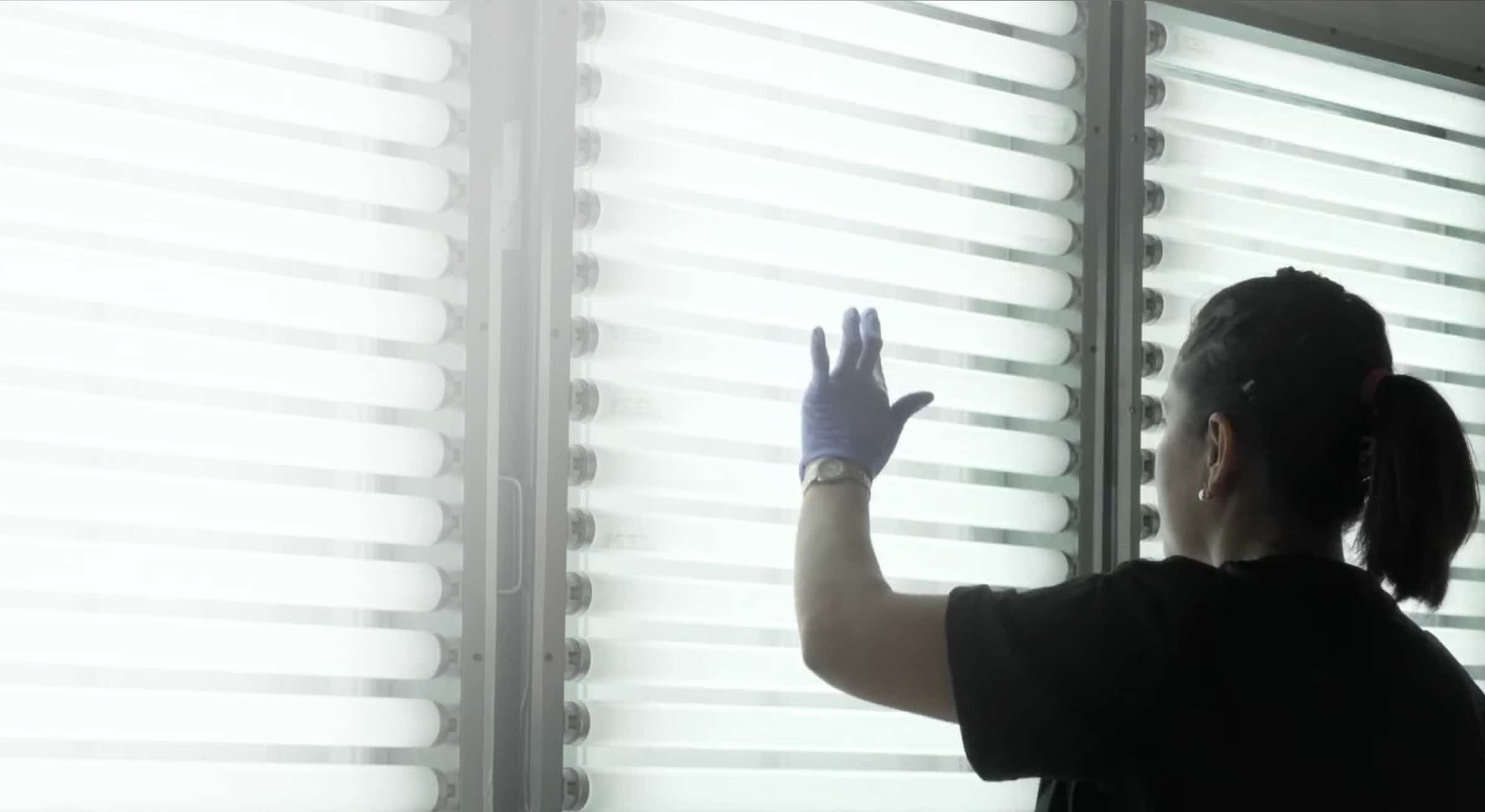
This targeted luminance tuning is achieved by sliding our custom-engineered **Calibrated Filter Tubes (Cat. No. 2427D85)** directly over the existing internal fluorescent lamps. Requiring less than one minute of installation overhead, this elegant modification applies instantly to our complete installed base of legacy boxes as well as brand-new production shipments.
A Cost-Effective Alternative: Retailing at just $45.00 per cabinet, these multi-layer sleeves eliminate the logistical need to completely replace an existing housing setup or purchase separate uncalibrated light boxes that frequently demand capital outlays exceeding $1,000.00.
General Lighting Latitude
Ever since our plant initialized the original trans-illuminated enclosures for the landmark Early Treatment Diabetic Retinopathy Study, our systems have been factory-tuned to 160 cd/m².
This standard was firmly established for general use by the 1984 International Council of Ophthalmology guidelines, which permitted a $2\times$ scale latitude in either direction (spanning 80 cd/m² to 320 cd/m²). For typical pathways, shifting within this zone impacts average threshold tracking by less than one letter line—well beneath standard clinical test-retest variability limits.
Isolating Optical Aberrations via Pupillary Aperture Scaling
For specialized research cohorts and multi-center clinical trials, selecting the exact candela output layer is a critical methodological step. The optimal luminance is directly determined by whether the trial focuses primarily on retinal changes or optical anomalies.
When investigators aim to monitor early-stage structural diabetic changes or micro-aneurysm tracks, the clinical goal is to minimize peripheral refractive errors by keeping the patient's pupil constricted. High chart luminance supports this pinpoint alignment. The original design protocols for the National Eye Institute ETDRS trials frequently implemented an intensified output curve hitting up to 345 cd/m².
Conversely, when evaluating advanced premium intraocular lenses (IOLs) or multifocal optics, practitioners must intentionally induce a wider pupillary aperture to unmask subtle higher-order aberrations. For lenses incorporating concentric refractive or diffractive zones, a wider pupil ensures light passes through all functional boundaries. This is why contemporary **ISO 11079-9 standards and FDA investigative paths mandate a lower 85 cd/m² setting**.
Mesopic Testing Channels
Beyond supporting standard photopic tracking at 160 cd/m² and 85 cd/m², our catalog features our legacy **Large Mesopic Chart Filter (Cat. No. 2424)**. This absorptive screen drops internal cabinet illumination down to exactly **3 cd/m²** to isolate vision performance under extreme low-light constraints. When executing mesopic protocols, practitioners must maintain absolute dark adaptation controls across the exam room to isolate the retina from erratic peripheral ambient glare.
85 cd/m² Lamp Filter Tube Kit (Cat. No. 2427D85)
A set of two calibrated sleeves engineered to down-scale standard output levels on your ETDRS enclosure down to an exact 85 cd/m² target line. Designed to slide instantly over existing internal fluorescent lamps, these tubes are guaranteed to preserve their filtering properties for a full year of routine use (indexed as 10 hours of daily operation over 365 days). Because multi-center clinical trials typically mandate refreshing bulbs annually, the degradation curves of the lamps and filter sleeves align flawlessly.
Sleeved Replacement Lamps for Cat. No. 2425
Every standard illuminator cabinet utilizes two high-output lamps, and engineering protocols strongly dictate replacing both bulbs simultaneously to eliminate localized luminance drift. Systems manufactured after November 2008 incorporate factory lamps with an integrated fenestrated sleeve permanently mounted onto the glass envelope. Order this specific model for seamless bulb swaps in cabinets lacking a removable metal sleeve mechanism.
Large Mesopic Filter Panel (Cat. No. 2424)
Mounted cleanly in front of standard translucent visual acuity or contrast targets, this rigid optical filter attenuates raw luminance output down to an uncompromised 3 cd/m² to map low-light degradation curves. It provides a clean, fast method to analyze scotopic/mesopic performance anomalies directly within your standard lane, avoiding the clinical overhead of moving patients across rooms or re-calibrating separate exam areas.
The Original ETDRS Illuminator Cabinet™
The definitive world standard for uniform retro-illumination of visual acuity charts, fully approved by the National Eye Institute (NEI) and mandated across FDA clinical trial frameworks. Features CE-compliant electrical ballasts available in multiple international voltages. Delivers flawlessly homogeneous lighting across all translucent $62 \times 65\text{ cm}$ ($24.5 \times 25.5\text{ in.}$) chart series. Built with an integrated rear storage slot and available in Traditional Beige or modern Cobalt Black. Measures $63 \times 65.5 \times 17.8\text{ cm}$ and pairs perfectly with our Adjustable Caster Wheel Base (Cat. No. 2426) or wall-mount arrays.
- Consilium Ophthalmologicum Universale (International Council of Ophthalmology), Visual Functions Committee. Visual acuity measurement standard (1984).
- Committee on Vision, National Research Council, National Academy of Sciences. Recommended standard procedures for the clinical measurement and specification of visual acuity. Report of Working Group 39 (1979).
- National Research Council, Committee on Vision. Measurement of Visual Field and Visual Acuity for Disability Determination. National Academy Press (1994).
- National Research Council, Committee on Disability Determination for Individuals with Visual Impairments. Visual Impairments. National Academy Press (2002).
- General-Purpose Clinical Visual Acuity Charts – ANSI Z80.21-2010 (Revision of ANSI Z80.21-1992). American National Standards Institute, Inc. (2010).
- International Standards Organization. ISO 8596 – Ophthalmic optics, Visual acuity testing, Standard optotype and its presentation (1994).
- Sheedy JE, Bailey IL, Raasch TW. Visual acuity and chart luminance. Am. J. Optom. & Phys. Opt. 61(9):595-600 (1984).
- Bailey IL et al. Visual Acuity: Variations with Optotypes. ARVO 2007-5514 (2007).
- Ferris FL, Sperduto RD. Standardized Illumination for Visual Acuity Testing in Clinical Research. Am J Ophth 94:97-98 (1982).
- International Standards Organization. ISO 11079-9 – Ophthalmic implants, Intraocular lenses, Multifocal intraocular lenses (2006).
Avoid Shipping overhead: Coordinate a Live Event Pick-Up
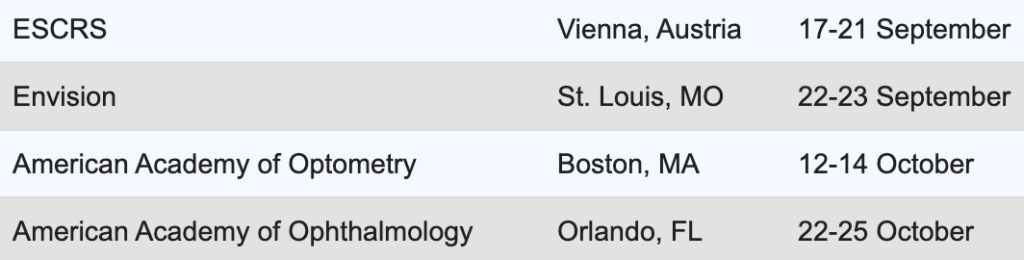
Precision Vision® regularly displays our full diagnostic product line across major domestic and international medical congresses. If you are attending an upcoming scientific assembly and want to eliminate domestic freight costs or international warehouse shipping delays, our logistics desk will gladly bring compact test sets and chart filters straight to the venue floor for you. Simply place your order through our digital store or contact our office at **800-772-9211**, and notify our staff which meeting booth should hold your package:
Share Your Clinical Workflow Successes
Precision Vision® values the real-world operational insights generated across our global network of eye care professionals. Tell us how your diagnostic team is deploying our calibrated filter tubes or mesopic tracking frames to protect clinical continuity. If you have an insightful study story or workflow calibration method to share, connect with our editors today to submit your observation for a future newsletter feature.